Bold-Career-Logo-200px
⌘K
About Free Assessment
Blog Testimonials FAQs
Schedule a Call
oOur Services
Job Search Program
Career Coaching
Interview Coaching
Live Job Opportunity Support
cCorporate Outplacement Services
aAbout
Free Assessment
rResources
nNewsletter
Free Career Assessment
iInterview Coaching | How an Interview Coach Can Help You
cCareer Coaching | Everything You Need to Know
Blog
Testimonials
fFAQs
Schedule a Call
Back to products

Advisory Sprint

Here’s a description. Here’s a description. Here’s a description. Here’s a description. vvHere’s a description. Here’s a description. Here’s a description. vHere’s a description. vv

Content

0 ~ Program Start & Reframe
Onboarding Steps
Survey
Your Profile & Background Survey
This short step helps us understand your background, current role, and how to contact you throughout the program. Having this information allows us to prepare properly and support you in a more personalized way from the start. It should only take a couple of minutes to complete, just have your basic details ready.
Survey
Your Career Direction Survey
This questionnaire helps us understand your goals, priorities, and current situation in more depth. Your answers will guide our work together and allow us to tailor the process to your specific needs, so we can focus on what will make the biggest difference for you. Take your time with this, it’s an important step and will make your first session much more valuable.
Worksheet
Career Reflection Worksheet
This step is designed to help you think more deeply about your experiences and what you want next in your career. Your answers will give us important insight into what drives you, what’s been holding you back, and how to best support you moving forward. This is a key part of building a direction that actually fits you. Set aside some quiet time for this, it’s worth being thoughtful and honest in your responses. Note that completed Worksheets live in your profile. You can access them anytime and update your answers when you wish to.
Upload Document in Your Folder
In this step, you'll upload documents relevant to our work together to your 0 - Background Docs folder in Google Drive (resume(s), cover letter(s), personality assessments, and other relevant materials). This helps us get to know you better and understand your starting point.
Theory
M1-1 Lesson Image.001 16:02
How to Think Like the CEO of Your Career
Our starting point is a reframe of how you live and lead your career. In your career, you where your job hat. You also need to where your CEO (of your career) hat.
1
M1-Lesson 2 Final.001 12:46
Be a Market Player
Discover how understanding market dynamics and positioning yourself as a valuable, unique professional can unlock hidden opportunities and enhance your career growth.
1
M1-3 Lesson Image.001 19:03
Uncovering the Systems that Drive Your Success
Discover the five essential pillars that drive your career success, providing a powerful framework to assess, plan, and elevate your professional journey. Learn how balancing internal strength, ex...
1
Bold Career Project Career Move Readiness 14:45
Getting Market Ready
This lesson emphasizes the importance of career move readiness and market skills, helping you confidently handle transitions, optimize your professional profile, and leverage networks for new oppo...
Action
Career Power Audit Scorecard (1) 1:20
Take the Career Power Audit
Discover your "career power" with Ian Christie’s quick, five-minute scorecard that reveals your current marketability and control over your career journey, empowering you to identify key areas for...
1 1
1 ~ Strategy
1.1 Clarity - Define Your Career Direction

Career Growth M0_L2_Identifying Your Starting Point 12:19
Your Next Professional Step
Your Next Professional Step - Define Your Starting Point & Influencers Why is this important? We want you to move forward in your career with intention. Whether you are currently stuck or thriving, happy in your role or ready to make a move, clear on your direction or exploring your value and what's out there, begin with a strong foundation.  What you'll learn:  The 4 energies that influence your next professional step The 4 quadrants of your current professional state The Big 3 + 2 + 2 priorities that influence your next professional step Big questions you might be asking now Understanding your powerful WHY The 7 strategies to move forward with confidence
2 1
Career Growth M0_L3_Professional Step Types 7:54
Your Next Professional Step pt 2 - Pathways
Discover the different types of professional steps—repair, consolidate, lateral moves, upward moves, and pivots—and learn how to identify your current pathway to effectively plan your career progr...
2 3
f46a798d-77af-4162-90d9-8a6ca9012685 19:25
Your Next Professional Step pt 3 - Guidelines
Week 4 - Strengthen Your Base. Plan Your Next Step. Objective: Incorporate, leverage and honor key the parameters in designing and seeking intentional and strategic professional steps. Take steps to identify and solidify your understanding of your intended path.  Missions:  Watch the video Add a comment/discuss: How did/will you use the ideas in this lesson to get clarity and congruence on your next professional steps and plan? What resonated the most for you? Is there something you're struggling with for which the group can provide support? Optional: Your next steps are a function of the meaning we've attaching to the career growth concept. I have added supplementary notes on key career growth themes below to remind/support your planning.  Reflect on and answer the questions in the workbook.    Which of the Four Career Growth Themes Makes Sense for You? Career Growth = Finding & Creating Better Alignment Navigate towards better fit… Organizational environments Working with people that suit you Less of the tasks and focus areas that don’t serve you Aligned with values, if important Working more in your “unique ability” Doing work that is meaningful to you This is career growth. Less accidental. Put yourself in situations where you can thrive.   Career Growth = Playing a Bigger Game Up the Ladder:  Road to executive Closer to CEO, managing partner, owner, Board Bigger, or more Prestigious Company size Clients or teams Portfolio Size of business, department More $$ / Earning Power   Career Growth = Creating More Market Power for Yourself What if you are doing well and in the right domain? For all who want more control over their journey and who want to play a bigger game, the prerequisite is market power. This is a type of career growth, where you’ve created increased degrees of freedom for yourself, increased demand. You'll undertake intentional, consistent career management practices to:  Develop, deepen, broaden your craft in areas of demand & strength Make aligned decisions driven from your unique professional assets Develop personal identity, build your reputation, cultivate a strong network and more…. Result in:  Increase of quality opportunity flow Increased degrees of freedom = More choice Ability to get opportunities created around your unique professional assets   Career Growth = Doing your Own Thing / Creating Your Own Future Career Growth is also very much about manifesting a future that you design. You don’t have to fit into a box. You can create your own. You might have a vision. A goal. Something to build, create. A way of working. Identification of what you want in your future... Shaping extra-curricular / side-gigs as a means of learning, earning, exercising certain skills and getting experience or as future exit vector Moving towards a hybrid model Engaging in a larger career change towards something you really want to be a part of Types: Ownership (projects, business) New domain More freedom Ways of working  
31bc36c3-cb8b-485f-8b57-dbe1a07243f5 11:55
Discover Your Habitat
Objective: A key purpose of the professional assets work is to better determine the habitats in which we can thrive. Another way of expressing this is a natural target market. Use this lesson to sharpen your understanding of where you thrive and want to go and what work is best represents your next professional step.  Mission:  Watch the video Answer the questions in the workbook related to this lesson.
1 1
photo-1531280518436-9f2cc0fff88a
Define Your Target
Professionals and leaders who have built a robust career platform are focused on a validated target market. They have identified a niche, or at most, a few niches in which they can serve and make an impact. Your market readiness, and the key to becoming career independent is putting your focus in the right sandbox. Time and time again, though, I witness two problems in the planning and management of professional careers: The absence of target market clarity or focus You cannot hit your target if you don't know what it is. You cannot build upon your successes if you keep trading in your experiences for totally unrelated ones. You cannot cash-in on the development of your expertise if you keep starting over. And in career transition mode, you cannot be successful without establishing targets. The pursuit of a target market or niche without validation I am certain that you have a lot to offer. The hard truth is that not everyone is going to be attracted to your professional offering. In fact, you are entirely unattractive and not suited to most professional opportunities! Unfortunately, too many people identify targets without any foundation of evidence that the target is doable. As mentioned in the last lesson, MBAs, for example, often fall in love with the idea of shiny job objects like strategy consulting or brand management without understanding what it takes or whether they are even suited. In the talent marketplace, your array of professional assets, from your experience, to skills, knowledge, personality and professional interests, are: Not all suited nor attractive to the majority of markets Partially suited and attractive to some markets And ideally suited and very attractive to one or a few markets A powerful question: Who would get you? Can you think of someone in your personal life who really gets you? The same principle applies in the marketplace for your talent. There are situations, whether they be jobs, contracts, or markets you can serve, where you are highly attractive, where the buyer would get you and your offering. Their interest in you typically includes a unique combination of: Experience: Something about your experience and experiences is attractive to the buyer. Experience can be a pre-qualifier (you need experience in our industry) or complementary (we need your new perspective) Proficiency: You have demonstrated that you have a high degree of competency in your job areas Expertise & Knowledge: You bring expertise and knowledge that they need, either because they don’t have it, or because they need more Strengths Fit: Your unique strengths are recognized, valued and relevant for the role Shared Interests: What turns you on and keeps you moving forward is compelling to them. They value your reason why. Fit: They like you and see an interpersonal fit. The want to work with you Thrive If you had this kind of clarity about your natural target market, imagine what it could mean for you. With attention on pre-qualified, natural target markets your conversion rate goes way up when you are seeking work opportunities You are working with colleagues, clients or customers who appreciate your full array of professional assets. They are grateful that you are working on theirproblems and opportunities You experience a greater degree of professional leverage because you are focused on your strengths, which begets more success You experience the opportunity and benefits of being your best professional self and not wasting energy trying to morph yourself into someone you are not I hope this lesson either reaffirmed for you that you are already working in the right sandbox or awakened a recognition that you have work to do to define either your sandbox and/or make progress towards getting there.
1
1.1 Actions & Playbooks
photo-1531280518436-9f2cc0fff88a
Homework - Professional Value Workbook
Instructions The Professional Value Workbook is a Google Doc. We will copy it into your folder. Read the instructions and proceed through the first steps, with the guidance of your coach.
1 1
7b84a050-6d28-4f40-a9ff-b6d7b8e7dc58 9:08
Explore Your Routes
Objective: Begin to fine-tune your direction using different distinctions/decisions, your drivers, goal planning and/or the niching concept. Be aware that there isn't necessarily a perfect answer or just one path available to you. The compass reminds us that while we absolutely need to orient ourselves towards a chosen direction, course adjustments are normal, necessary and often can produce wonderful and previously unplanned alternatives.  Missions:  Watch the video Take action in the workbook on the questions that apply to your situation. Post/Discuss: How did the concepts in this lesson help to clarify, shift or expand your thinking about your path forward? What's holding you back from greater clarity?   
1
photo-1531280518436-9f2cc0fff88a
Values List
Resource - Values List If you’d benefit from identifying your values (for the Step 3 exercise in this module), the attached Values List provides a handy reference for highlighting a long list and narrowing it down.
1
photo-1531280518436-9f2cc0fff88a
When to Target a Lower Position
KEY TAKEAWAYS | Downshifting can help move your career forward if the job fits into a larger long-term plan or re-orients your work-life balance. Be prepared to shift how you sell yourself for a lower-level role. Does it ever make sense to take a step down the career ladder? If you can get past that nagging, inborn sense that "going lower" can only be a sign of downward career mobility, the answer is yes. Taking a lesser position—downshifting, as it's sometimes known—can help move your career forward if the job fits into a larger long-term plan or re-orient your work-life balance. Find out when a lower position might make sense and how you can make such a transition successfully. Know why What could drive you to consider a lower position? Here are some common circumstances: Necessity: Economic conditions, your financial situation, and lack of other alternatives may necessitate taking the best available option — even if it's a step-down. There's no shame in this, but be honest about how you got into this situation in the first place. Some people make this career decision out of avoidable necessity — they are forced to take a lower-level job because they didn't take charge of their careers. Do what you have to do, but learn from it. In other cases, your local job market doesn’t contain comparable roles, and to avoid relocating, downshifting is necessary. To change careers: This is a completely valid reason to take a lower position, but remember: Changing professions doesn't automatically mean you start at the bottom. Look for transferable skills or specialized knowledge that could allow you to slide into something above an entry-level role. Also, changing industries is not the same as changing professions. When you change industries but not functions target a lateral position, not a lower one. For example, a finance director in a software company can occupy the same role in a biotech company. To broaden your horizons: A lower position in a different department can provide new experiences and enrich your career. But as with any career decision, think about the fit, your ability to be successful and how such a move figures into your larger career plan. To find another way to advance: Imagine climbing a mountain and reaching a point where the route is blocked or requires climbing skill beyond your ability to pass it. You can give up or make a tactical decision to go back down a bit to look for another route up. Taking the right lower position can be a smart tactical move if you believe you can be successful in the lower role and know there's a defined path on which you can continue your ascent. Opting to gear down: During the reunion, one friend told me he had chosen to step down a level to get out of the demands of VP-life in an international company. The result? “I feel no stress from work.” For others, it was a general sense of not needing to build their resume and compete in the race. What are the signals that it might be time to shift down? Financial - When you’ve saved and planned and feel secure in your future. Physical Health - When health issues have arisen, or you want to prevent the damaging effects of stress and overwork. Mental Health - When you realize that a) you don’t need the psychological payoffs of career advancement anymore and/or b) your current level is costing you more than it is beneficial. Time & Lifestyle - When the benefit of more non-work time and margin outweighs continuing to work longer hours. Fun - When you realize you’re not having as much fun at work or are drawn to other endeavours. Sell yourself Once you've determined why taking a step down makes sense, prepare to sell yourself differently and potentially hard. Your approach to marketing yourself for higher-level roles will need to shift. You may be up against more junior candidates, so you'll need to overcome the hiring manager's perceptions that you are overqualified and will get bored and leave. To convince them otherwise, express positive, compelling reasons you want the job. Convey why you want this new role, not why you’re moving away from the previous level/role. Avoid sending negative messages. In all of your communications, demonstrate you: Possess the energy and enthusiasm to do the job and the flexibility, ability and willingness to learn quickly. Will bring more value to the role based on your work experience than an untested junior candidate. Will be content to do the job you are hired for and won't be making waves three months after you start about moving up. In situations like this, it's human nature to feel superior to your junior coworkers. But acting superior will only torpedo your plans. Be mindful of your development in the role, and manage your performance. If you remember that the lower position is just one step in a long-term career strategy, you will perform well and with purpose.
1.2 Clarity - Claim Your Professional Value

ada35021-50ac-4f0e-8552-1c9d297173cc 16:51
Discovering Your Professional Assets & Your Professional History
Greetings. I wanted to give you a heads-up on this module. This module is a keystone topic, one that informs much of the rest of the program. I recommend that you watch all of the videos and use the workbook. Objective: As the hero of your professional journey, we need to understand your attributes - who you are professionally. This is keystone work that informs your confidence, direction, branding, competition for new roles and your overall professional identity. Use this lesson and the following two lessons in this module to begin to identify your professional assets.  Mission:  Watch the video Navigate to the Homework lesson that follows.   Add a comment and discuss below. 
1
310526e6-6d6f-462f-9be2-41f5ba2db610 14:06
Uncover the DNA that Enables Forward Moves
Objective: Engaging in a process to discover your gifts, find the value in your experience, hone in on your interests, and take ownership of your work style and motivators is important, even heroic work.  Why? Because the world needs you to be at your best. Because your overall well-being requires a level of fulfillment from your career which comes from being in the right place for you. And because gaining clarity on your unique value opens up possibilities.  Anything truly important isn’t easy and this lesson and module is not meant to be the one-shot, definitive end of your personal discovery. It is a process and part of the journey. And, it’s the most important step if you’re interested in owning your professional direction. Understanding what you offer => get definition on your natural target markets (jobs, organization types, and situations) => defining your true targets => and then, understanding your buyers and connecting the dots between what you offer and their needs (which leads into a resume, LinkedIn profile and interviewing fine-tuning).  Let’s get started. In this lesson, we build on the experience analysis work of the previous lesson by beginning to identify and label our key assets. Mission:  Watch the video Answer the questions in the workbook related to this lesson.  Add a comment and discuss below.    Professional Assets Model  
1
Create & Declare Your Market Promise(1) 10:27
Create & Declare Your Market Promise
Objective: Understand how developing your market promise and "connecting the dots" between your target and your offering creates a much stronger strategy, improves your presentation and personal brand and gives you guideposts to develop your capabilities.  Missions:  Watch the video Address the market promise questions based on your situation and level of clarity about your next step. This will be very important if you're looking to "compete" for opportunities soon. If not, make basic notes. Regardless of your situation, do attempt to isolate the competencies expected/required of your current or next step role and your proof points.
1cdf5f4f-5f50-4197-ae73-186e79ff261d 15:02
Tap into Your “Why” & “How” to Drive Future Career Growth
Objective: We continue your professional assets discovery by gaining clarity on your motivators, professional interests, and work personality and strengths. These form your "why" and "how".  Mission:  Watch the video Answer the questions in the workbook related to this lesson. I have included a values list reference doc if helpful for you.  
1
photo-1531280518436-9f2cc0fff88a
Jobs Analysis Coaching
Instructions:  Read the sections below on Additional Coaching on Job Analysis and Additional Power Concept  Download the workbook from this lesson Answer the questions in the workbook related to this lesson. The key experience and expertise element slides are inserted below for your reference. The goal for this week is to begin to inventory your experience.  How deeply you dive into the workbook and analysis really depends on your appetite for it and what your goals are. The more that you see a shift, a pivot, a change coming up in your career, the more vital this work is. I suggest that this is something that you could come back to through the program and after. Your coach can guide you. As with the other workbook steps in this module, take guidance from your coach as to what is most important for you to complete. Additional Coaching for Jobs Analysis Work Few people have a suitably clear and full grasp of where they have been professionally. Within your background are clues, stories and data that help drive and support career changes. The Jobs Analysis exercise is a cornerstone activity, and if you dig deep enough, it will provide you with the framework to think about the jobs you have held and give you some avenues to dredge up situations/experiences/stories. The following are areas where you may need to capture your background more thoroughly: Data around specific accomplishments and performance How you made a difference / added value Intangible outcomes (and making them a bit more tangible) The context of roles and the delta between what you inherited when you took on the role and what you, or your leadership, helped or caused to be produced by the time you were done. Where to Look For each job in your career, and any other significant activities, use the following prompters to get you started: Responsibilities: At the most basic level, how fully did you fulfill the responsibilities of the role? Objectives: What objectives were you given? Did you meet those objectives? Exceed? Projects: What projects were you involved in, what was your role within those projects, what did the project achieve, and what was your contribution to that outcome? Initiative: Did you show initiative in proposing or implementing a new or better way of doing things, or seizing an opportunity Problems: Did you solve any important business or people problems? Crises: Were you involved in managing a crisis and if so, how did you contribute? People: Have you had any people wins? Developed an employee? Successfully mentored someone? Turned an unproductive working relationship into an effective one? Overall, what difference have you made in each of the jobs you have held? What have you been rewarded or recognized for? Where have you excelled? This process will add confidence and power to your career management and development efforts. This tool allows you to analyze your current or past jobs at a depth that you likely haven’t done before. Note 1: Take as much space as you need to fully develop your ideas. Note 2: Be as specific as you can, which may mean digging. Make the outcomes as tangible as possible. Note 3: If you have held a role in a charitable organization, or in your own business, please include. Additional Power Concept - Deltas Created In the workbook, there is a job analysis exercise. I ask you to make note of the context of what was going on in that job. When we begin a new role, contract, or client situation, we inherit a state, a context. That's Time 0. Over time, the impact you create might be measured as a delta - that is, the positive change over time in one or more areas:  Size of the portfolio (territory, staff, budget, etc.) Key performance indicators around revenue, profitability, efficiencies, customer satisfaction, quality, etc.  Creation or improvement of new processes, systems, tools, projects, programs, products, etc.  Intangibles like culture, market reputation, etc. When you think of it this way, you can better uncover your accomplishments and learn more about where you've added value. This is a powerful lens   Slides - Elements of Experience & Expertise
1 1
photo-1531280518436-9f2cc0fff88a
Putting it Together - Professional Value
Purpose Now that you’ve completed the work from previous steps in uncovering the various aspects of your experience, your skills and knowledge, your interests and values and your work personality, it is time to start putting it together. Your coach will help you assemble the key pieces including: Your key abilities Your professional track record and key assets from your experience Your areas of knowledge and expertise to leverage And your key, go to market skills, competencies Determine your most important professional interests Define which parts of your work values and your work personality are assets Decide your your “lead” go-to-market professional assets  
1.2 Additional Resources
photo-1531280518436-9f2cc0fff88a
15 Sources of Competitive Advantage
Defining Your Professional Assets On your professional journey, you have competition for great work situations, bigger roles and client projects. What is your competitive advantage? Manage your Destiny In the realm of managing your career, I can make some safe assumptions. You don’t want to be interchangeable with the person next to you. You would like a surplus vs. scarcity of professional opportunities. You want to be able to negotiate for work and compensation at least as an equal partner in the conversation, if not from a point of strength. So, finding and building competitive advantage deserves your attention. What is Competitive Advantage Michael Porter defined two sources of competitive advantage for companies: lower cost and differentiation. Now, you may want to play the lower cost game, but I doubt it, so let’s focus on differentiation. This is not about wearing a power blue tuxedo to a formal business event (seen it), or formatting your resume in a wild font to get attention. Another definition of competitive advantage refers to it resulting from finding a match between the company’s core competencies and the right market opportunities. Bingo! True professional competitive advantage results from identifying and developing your areas of strength (defined in its broadest sense) and connecting with your natural target markets. When it comes to competing for key roles, the result is a natural, obvious fit between seller (you) and your target buyers. 15 Sources of Competitive Advantage Keep these three points in mind as you go through the list: Rarely is your professional competitive advantage one-dimensional For most work, there is a base layer of competency required. Even if you have an area of exceptional strength, you need to have the bases covered Some sources are a result of years of attention and performance. Others can be developed or enhanced in the short to medium term. Superior Domain Expertise: When you are the go-to resource for X, you have created a competitive advantage. Your name is known outside of the walls of your department. Perhaps you have spoken at a conference. Whatever it is, possessing superior knowledge over most of the pack gives you an advantage when it comes to opportunities requiring that same expertise. Rare Domain Expertise: In a category in and of itself, there are areas of professional expertise that aren’t necessarily new, but they are rare. Demand / supply curves being what they are, you can leverage this relatively scarce expertise. Ahead of the Curve: While not always a permanent source, you having advance expertise and experience in something that is both new and important – a key technology or application, regulatory changes, the latest management fad, or in-depth knowledge and contacts in the latest emerging market, can be a real boon. It can put you in the spotlight in your current work situation and open up doors to new ones. Executive recruiters are often retained to find this ahead of the curve expertise, as well as rare expertise. Superior Skill in an Area of Demand: Skills are similar to domain expertise. While rarely is just one skill involved, except for the most specialized professionals, your demonstrated excellent in an in-demand skill, or related package of skills is a source of differentiation and advantage. Particularly when backed up by respected industry credentials. Network, Reach, Audience: The more relevant, engaged, extensive and supportive your professional network, or audience, the greater advantage you have. Why? Access to information, referrals and recommendations. The halo effect of being acquainted with key influencers. The opportunity to spread your message to a group of people relevant to your domain. This is a big one. Reputation & Track Record: Longevity isn’t enough. What is your track record? Between similar candidates, the person who can demonstrate a track record of performance and making a difference will have the leg-up. And in career change situations, a track record of successfully tackling a diverse set of challenges can be an important asset. Experience: Recruiters and experienced hiring managers have seen enough candidates to form an impression of a person’s total experience. The data that forms that impression includes your trajectory and progression, years of relevant experience, continuity of your professional story and whether or not there are questionable gaps. Experiences: Deserving of separate mention, and connected to your expertise are the special experiences that you’ve worked through. Product launches, turnarounds, acquisitions, regulatory approvals, campaigns, crisis managed. Two people could have similar job titles but have entirely different experiences. These situations, particularly when experienced more than once, can be a strong source of competitive advantage when a buyer is facing similar situations. Pedigree / Brand Halo: All things being equal, employer and customer brands that are from my space, or that I at least recognize, if not admire, give you a head-start over someone who has worked for / with companies that mean nothing to me. Unfortunately, there is often a size bias. I am more likely to have heard of a company that has scaled or is in the news or on lists. Polish & Finesse: While not the most important, polish and finesse count, particularly in those key career moments – the pivotal coffee conversation, the interview, the negotiation, the pitch. Skill, expertise and experience being equal, polish can take you over the finish line and in some cases trump one of the more tangible requirements. A Sponsor: Beyond an engaged network, having a senior champion who is willing to open a key door for you and lend their support for your candidacy can get you access to opportunities not widely available. Demonstrated Commitment: When it comes to getting in with a lack or direct experience, or competing for work among a host of other contenders, your tangible, demonstrated commitment to the business / topic at question can be immensely advantageous. Not the, I am very, very, very interested in this job approach. Even those two extra very’s won’t cut it. What you have done, attended, published, created, studied, developed, built, read, etc and how articulate you are about the area of business are what count. Your commitment should leave footprints in the sand. Survivor of Cycles / Hard-knocks: Hey, I’d pay for someone who learned what needed to be learnt on someone else’s dime rather than mine. Gone through three startups and understand the ramp-up and funding cycles? Hugely valuable if I am a start-up CEO. Fought through tough market cycles and found a way to survive? Fantastic. Atypical for your Field: Here’s a good one. There is a type for a lot of professions and fields. A common set of personality traits, core skill sets, shared values. What if you have the base layer AND something else that makes you atypical? Case in point: In the large accounting firms, it usually isn’t the best / most technically savvy accountants that rise rapidly through the ranks. Rather, it is those who have that base layer of competency combined with team leadership qualities, client relationship skills and the drive to build the business. Targeting: The market is big and you are not equally valuable everywhere. Your ability to identify and cultivate areas of opportunity – in your organization, profession, market and industry is a must-have component to your professional advantage. Your Unique Combinations Remember where we started on differentiation. At the end of the day, your professional competitive advantage is likely a combination of things. What you have focused on and how you articulate who you are professionally can make all of the difference. There’s no excuse to be a cog. What are your sources of competitive advantage?
2 ~ Marketing
2.1 - Winning Mindset, strategy and system
photo-1531280518436-9f2cc0fff88a
The Iceberg
The Rest of the Iceberg If you're looking for career opportunities, you want to find ways to access the rest of the iceberg. Earlier we mentioned that there are 3 ways besides advertised openings, that people find jobs. Through informational interviews, referrals and/or sending resumes to targeted companies, job seekers find positions before they're advertised.Job seekers cause a job to be created for them. More specifically, around the solution, expertise, or potential that they represent. Hiring managers and recruiters find candidates through their own networks or through head-hunters. Notice that these 3 markets are hidden, or not visible or advertised to the public. That's why they require a more proactive approach. Getting the right opportunity by applying on a job board can be like finding a needle in a haystack. These jobs not only have the most competition, they also represent only 1 out of 4 ways that companies fill positions. That means your career search could be 75% more effective by taking advantage of the other methods that companies use to hire. All it takes is a proactive approach.
Bold-Career_Playbook_Non-urgent-Job-Search-Cadence-thumb
Set Your Pace: Job Search Cadence Playbooks
Set Your Pace: Job Search Cadence Playbooks Your job search is a system. Not a to-do list. Not a burst of energy on a Monday morning that fades by Wednesday. It is a repeatable weekly rhythm that keeps you moving forward, even on the days you do not feel like it. Most people get this wrong. They either go all-in and burn out in three weeks, or they drift along hoping something will land in their lap. Neither works. What works is a cadence. A structured, sustainable plan for how you spend your time each week on the activities that actually lead to interviews and offers. Think of it this way. A job search is a go-to-market campaign. You are the product. And like any campaign, the strategy depends on your situation. Someone who is unemployed and needs income now is running a very different play than someone who is employed but ready to make a move. And both of those are different from someone who is stable but wants to stay sharp and build options. That is why we have built three cadences, not one. Your job is to pick the one that fits where you are right now and run it. The Three Cadences 1. Unemployed and Urgent You need income. Job search is your full-time job. This cadence runs 35 to 40 hours a week with a structured daily rhythm, morning, afternoon, and evening, that puts your best energy toward the highest-leverage activities. It is intense but designed to protect your mental health along the way. 2. Employed and Semi-Urgent You have a job, but you need to move. Maybe the writing is on the wall, maybe the role is just not right anymore. You are carving 12 to 15 hours a week from mornings, lunches, and evenings. Every hour counts, so this cadence is ruthlessly focused on quality applications, warm introductions, and getting in front of the right people. 3. Employed and Non-Urgent But Active You are stable. No fire to put out. But you are smart enough to know that the best time to build your network and your reputation is before you need them. This cadence runs 5 to 8 hours a week and is designed to compound over time. When the right opportunity shows up, you are ready to move fast. What Makes a Cadence Work Every cadence is built on the same engine. A weekly rhythm. Each week has a shape. Specific days are mapped to specific types of activity, whether that is applications, networking, follow-ups, or interview prep. A week is long enough to build momentum and short enough to course-correct if something is not working. The right mix of activities. Every cadence balances four things: getting visible (Reach), building relationships (Relationships), strengthening your positioning (Reputation), and converting opportunities into offers (Results). The proportion changes depending on your situation, but the categories stay the same. Clear targets. Each cadence includes weekly metrics so you know whether your system is working. Not just "I feel busy" but "I had 10 networking conversations and submitted 5 quality applications this week." If the numbers are off, you adjust. If they are on, you keep going. Built-in recovery. A job search is emotionally draining. Every cadence includes hard stops and protected time for rest. Burning out does not help you land a role. Sustained, focused effort does. How to Choose This is simple. Ask yourself two questions: Am I currently employed? How urgent is the move? If you are unemployed and need income, start with the Urgent cadence. If you are employed and need to move within the next few months, start with Semi-Urgent. If you are employed and building for the future, start with Non-Urgent But Active. And here is the important part: your cadence can change. If you are running the Non-Urgent playbook and your company announces layoffs, you shift to Semi-Urgent. If you get a layoff notice, you shift to Urgent. The playbooks are designed so you can move between them as your situation evolves. What to Do Next Open and download the playbook that matches your situation. Each one gives you a ready-to-run weekly plan with specific time blocks, activities, and targets. It is not a theory document. It is the plan you follow starting this week. If you are not sure which one fits, bring it to our next session and we will figure it out together. Your job search has a pace. Let's make sure it is the right one.
3
photo-1531280518436-9f2cc0fff88a
Think Like a Pipeline
Think Like a Pipeline - Work the Opportunity Funnel Here is the truth about job search that most people never hear: you are running a sales pipeline. Not in a sleazy way. In a strategic way. Every salesperson knows that deals do not close themselves. You have to fill the top of the funnel, move opportunities through stages, track what is converting and what is stalling, and never, ever let the pipeline go dry. Job search works exactly the same way. Most job seekers do not think like this. They apply to a handful of roles, wait, check their email obsessively, and wonder why nothing is happening. Or they get one exciting conversation going and pour all their energy and hope into that single opportunity while everything else stops. That is not a strategy. That is a gamble. The Opportunity Funnel gives you a different way to think about your search. It is your dashboard. It shows you where things stand, where things are stuck, and what you need to do next. And when you combine it with your Job Search Cadence — the weekly rhythm you are already running — you have a complete operating system. The cadence fills the funnel. The funnel tells you whether the cadence is working. The Six Stages Your job search pipeline has six stages. Every opportunity you are pursuing sits in one of them. 1. Networking / Referrals / Posting This is the wide mouth of the funnel. It is everything you do to create possibility. Conversations with your network, attending events, engaging on LinkedIn, scanning job boards, asking for introductions. Nothing specific has happened yet, but you are generating activity and visibility. Volume lives here. 2. Leads / Applications Now you have a target. You have identified a specific role or company and taken action. You have applied, been referred in, or expressed direct interest. The opportunity has a name. 3. Initial Contact / Screening A human being on the other side has responded. A recruiter has called. A hiring manager has replied to your message. You are in a real conversation now. This is where you go from "one of many" to "someone worth talking to." 4. Formal Interviewing You are in a structured process. Panel interviews, presentations, case studies, multi-round conversations. The company is evaluating you seriously, and you are evaluating them. 5. Short-Listed You are one of the final candidates. The decision is close. This is where preparation, references, and how you have shown up throughout the process all come together. 6. Accepted Offer / Deal Done. Terms agreed, start date set. Pipeline complete for this one. The Key Measure: Conversion Here is where this gets powerful. The most important thing about the funnel is not how many opportunities are in it. It is how well they are moving from one stage to the next. That is conversion. And each conversion point tells you something specific. Networking to Leads: Are your conversations generating real opportunities, or are they just pleasant chats? Leads to Screening: Are your applications and outreach getting responses, or disappearing into the void? Screening to Formal Interview: Are you making a strong enough impression in that first conversation to move forward? Interview to Short-List: Are you performing well enough in structured interviews to make the final cut? Short-List to Offer: Are you closing? Are references, negotiation, and final impressions landing? When you track this, you stop guessing. You start diagnosing. "I am not getting anywhere" becomes "I am getting screens but not converting to interviews, so I need to work on how I show up in that first call." That is a solvable problem. Bottleneck Analysis: Where Are You Stuck? The funnel makes the problem visible. Wherever your pipeline narrows faster than it should, that is your bottleneck. Here is what each one usually means: Top of funnel is empty Not enough networking activity Not enough applications going out Too passive, waiting for things to come to you Fix: Increase volume. Go back to your cadence and make sure you are hitting your weekly targets for outreach and applications. Applications but no screens Your positioning is off. Resume, LinkedIn, or cover materials are not landing. You are targeting the wrong roles or companies Fix: Get feedback on your materials. Tighten your targeting. Make sure your value proposition is clear and specific to each role. Screens but no interviews Something is breaking in the first conversation. Your story is not clear, or you are not connecting. Fix: Practice your pitch. Record yourself. Work on how you articulate what you do, what you want, and why this role. Interviews but not getting short-listed Interview prep or performance is the issue. You are getting in the door but not standing out. Fix: More prep. More practice. Get specific feedback from your coach on where you are losing ground. Short-listed but no offer Final round execution, references, or negotiation Fix: Tighten your closing game. Make sure your references are prepped and aligned. Review how you are handling the late-stage conversations. The whole point is this: instead of panicking, you diagnose. You find the bottleneck, you fix it, and you move on. The Pipeline Rules These are the behaviors that keep your funnel healthy. Break them at your own risk. Never stop filling the top. This is the number one mistake. You get a promising opportunity. The conversations are going well. You start to feel hopeful. And you stop doing everything else. You stop networking. You stop applying. You stop reaching out. Then the opportunity falls through. And your pipeline is empty. You are starting from zero, emotionally wrecked, with nothing in motion. Do not do this. No matter how good a single opportunity looks, keep filling the top. Always. The pipeline protects you. Opportunities that are not moving are dying. If something has been sitting in the same stage for two weeks with no action, no response, no next step, it is stalling. Follow up. Re-engage. And if it still does not move, be honest with yourself about whether it is real or whether you are holding onto it because letting go feels like losing. Volume at the top. Quality in the middle. Early stages reward activity. Get conversations going, get applications out, be visible. Later stages reward preparation and performance. When you have a formal interview, that is where your energy shifts to deep prep. Adjust your effort to match the stage. Track it. If you are not writing it down, you are guessing. Use a simple tracker. A spreadsheet, a Notion database, even a piece of paper with six columns. Put every active opportunity in its current stage. Update it weekly. This is how you turn a feeling into data. Why This Matters A pipeline gives you something that job search rarely offers: a sense of control. You can see where things stand instead of just feeling overwhelmed. You can spot problems early instead of discovering them after months of spinning your wheels. You can make decisions based on data instead of anxiety. And most importantly, it keeps you from putting all your emotional energy into one basket. When you have multiple opportunities at different stages, no single rejection can knock you out. You absorb the hit, adjust, and keep moving because there are other things in the pipeline. That is the difference between a job seeker who is reacting and a job seeker who is running a campaign. What to Do Next Set up a simple tracker with the six stages as your columns Place every active opportunity in its current stage right now Look at where your pipeline is thin or stuck. That is your bottleneck. That is what we work on. Bring your pipeline to your next coaching session. We will diagnose it together and build a plan to fix what is not converting. Your cadence keeps the rhythm. Your funnel shows the results. Together, they are your job search operating system.
Master Digital.001 18:05
Master Digital Job Search
In this lesson, discover essential digital mastery techniques to enhance your professional journey, including effective online searching, optimizing your visibility, and navigating automated scree...
1
2.2 - Networking & Visibiity Best Practices & Actions

photo-1531280518436-9f2cc0fff88a
Marketing Intro - The 4 Rs - Relationships, Reach, Reputation & Referrals
This is the first of a series of “interludes” you will work through as we go through this process. The first modules are foundational and linear, setting you up for career transition success by developing a solid strategy centred around you. There’s an in-depth module coming up later in the program, setting you up for your marketing efforts. While we are working on the first modules, we can get a jump on your outreach efforts with a parallel set of discrete tasks so that we will already have momentum on the marketing side. For this first module, read below. The 4 Rs Whether you are completely engaged in your current role or looking to make a career move or career change in the coming year, the secret to ensuring that you thrive is to build and protect the 4Rs. As an actor in the marketplace, you aim to generate demand and optionality over time. My model for creating this is the 4Rs. The 4Rs are the pillars of your marketability. They help: - ensure your security in your current role - connect you with key people in your professional eco-system - generate a flow of professional opportunities - and more. Reputation / Your professional reputation is all about the equity you’ve built over your years of academic and professional work for your work quality and professionalism. Relationships / Your professional relationships are the lifeblood of your career, fuelling your ability to get things done, generate opportunities, and stay informed in your domain. Reach / Your reach is a measure of how far that reputation spreads. How known and referable are you for your “thing” (outside of your office)? Referability / Your referability is a measure of how easy it is for your network to recommend you and how often it happens. In each future module, you’ll have a task related to starting the process of building the above.
Career-Growth-M6_L3_People-and-Reputation-hd(2) 30:10
People & Reputation
Objective: This is a two-pronged (and longer lesson) covering the related topics of our connectivity/network and our reputation. Given all that we've covered in this course so far, you can see that your professional relationships are conduits. To referrals, information, social connection and opportunity. Strategically building this asset is a way of taking your professional identity and extending you reach into the market to further your goals and future vision.  For most mid-career professionals I know, professional reputation is nebulous and something that just happens. I challenge you to take ownership of and build this vital asset. Mission:  Watch the lesson video Comment/Discuss: What holds you back from embracing habits and practices to build your professional network? To what extent have you taken your professional relationships for granted? What approaches/strategies have worked for you? How will you behave differently going forward? What are the potential roadblocks to following through?  Comment/Discuss: For the section on professional reputation, what resonated with you? What was challenging? How can you leverage the concepts of this lesson to build your reputation? 
2
Career Growth Have Conversations(1) 20:45
Conversations
Discover the essential skills for having impactful professional conversations that build relationships, create opportunities, and leave a strong, authentic impression. Learn how to prepare, commun...
Bold-Career-Job-Search-Playbook_Professional-References-thumb
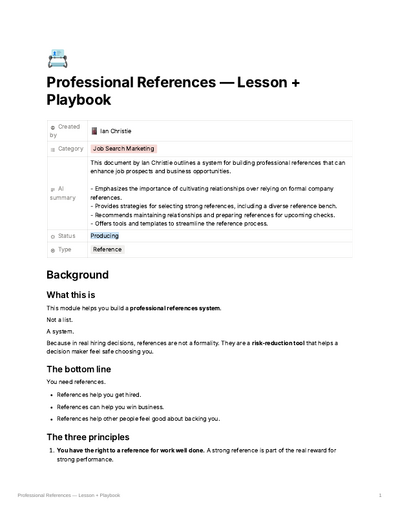
Playbook | Assemble Your References
Who are your Champions? When the time comes for you to be on the shortlist of an opportunity, you will need references. Beyond those 3-6 names, there are others who might be happy to say or write something about you. These could end up being LinkedIn recommendations, testimonials, or other. Instructions See the downloadable PDF for a complete playbook Write down who you assume or plan to be your references. Who else could be a reference, potentially write a LinkedIn recommendation, or act as a referral source? Think about the people you’ve worked with over the years, in your various roles and employers. To help, here are the categories of people to look for: Your direct managers going back through your career Peers to your manager who you interacted with More senior people to your manager who know/knew you and saw the impact of your work Your peers - cross-departmentally. People you had in-depth work with. People you worked with external to the organization - partners, customers, vendors, consultants Your subordinates, direct or dotted line, particularly those who thrived under your leadership. You’ll add to this list over time and we will discuss how to put into use. For now, do a quick brain dump. What this is This module helps you build a professional references system. Not a list. A system. Because in real hiring decisions, references are not a formality. They are a risk-reduction tool that helps a decision maker feel safe choosing you. The bottom line You need references. References help you get hired. References can help you win business. References help other people feel good about backing you. The three principles You have the right to a reference for work well done. A strong reference is part of the real reward for strong performance. Your references can be powerful allies as you navigate your career. In today’s social world, “references” are bigger than 3 or 4 names on a document. Your goal is a network of people who will vouch for you formally and informally. What’s changed (and why you cannot ignore references) A growing number of US and Canadian employers have moved to work-confirmation-only policies. That creates a career-management bottleneck. You cannot change company policy. So your strategy must shift from: “My company will give me a reference.” to: “My relationships will speak for my work.” Key mindset: rely on relationships, not goodwill If you have a close relationship with former managers, peers, and direct reports, you can still get meaningful references. If someone cannot or will not speak candidly because of policy, thank them and choose someone else. The employer’s point of view (the buyer psychology) If you’ve reached the reference stage, hiring decision makers usually want to buy. They are trying to avoid being wrong. Three realities to anchor on: Everyone is pressed for time. Waste their time and they resent it. Make it easy and they appreciate it. If you’re at the reference stage, they want to confirm their decision. “We think you are the right person for the role. Let’s confirm that.” Safe and known beats unknown. References help you become “known” through other people’s eyes. What employers are actually looking for Most reference checking is based on one premise: Past behavior and performance is the best predictor of future behavior and performance. When employers check references, they are usually verifying: You are who you say you are. Your character, credibility, and trustworthiness. Your performance, outcomes, and patterns. Proof of relevant skills through specific examples. Your leadership and interpersonal style. Fit with the role, team, and manager. Warning flags and inconsistencies. How to best manage you. Three failure modes to avoid 1) The Setup If praise sounds uniform, overly polished, or coached, it triggers suspicion. 2) The Stale Old references cannot recall specifics. They may like you, but they cannot help you. 3) The Unavailable Work-confirmation-only policies can produce references who are polite but useless. Your referencing strategy 1) Build a reference bench, not a reference list Your goal is a bench of people who can speak with specificity. Aim for: At least one superior (ideally one per meaningful role). At least two peers. At least one direct report (if applicable). At least one written testimonial from a delighted customer or employer. 2) Use an “enthusiasm threshold” Have at least two people who are eager to speak honestly and enthusiastically about you. If someone is hesitant, constrained by policy, or lukewarm, treat it as data and replace them. 3) Make it easy for the reference checker Assume they are busy. Your job is to remove friction: Correct contact info. Clear roles and relationship labels. References briefed on the exact role. 4) Maintain references like a career asset References decay if you do not maintain relationships. Set a simple maintenance cadence: Light touch every 3 to 6 months. Reconnect immediately after a major win. 5) Protect confidentiality when currently employed Be explicit about: Who can be called. Who cannot be called. What timing is safe. Playbook Below is the action sequence. Step 1: Build your Reference Bench (60–90 minutes) Create two lists: Primary Bench (use today) Backup Bench (if asked for more) Use the mix rules: Superior Peer Peer Direct report (if applicable) Customer/employer testimonial Step 2: Run a “specificity test” (15 minutes per person) Before you ever submit a name, confirm the reference can speak to: 1–2 projects you worked on together 2–3 outcomes you delivered Your working style and leadership approach Any red flags they might mention If they cannot give specifics, they are not a strong reference. Step 3: Keep your reference list clean and current (30 minutes) For every person on your Primary Bench, capture: Full name Current title Current company Best email Best phone Preferred contact method and time window Step 4: Notify and brief references every time (10 minutes) When a check is coming, send: Who will call When they will call What role it is for What matters most in the role Step 5: Build “social references” (ongoing) In today’s market, your references ecosystem includes: People who will give LinkedIn recommendations People who will introduce you to hiring managers or recruiters People who will vouch for you informally behind the scenes Tools and templates Tool A: Reference Bench Worksheet (copy/paste table) Reference Type (Manager / Peer / Report / Customer) Context (company + role) Best outcomes they saw (2–3 bullets) What they can credibly say (3 bullets) Last touch Next touch Tool B: Reference Brief (send before checks) Copy, paste, and customize: Subject: Quick heads-up re: reference call Hi [Name], Quick heads-up that, [Company] may contact you as a reference for a, [Role Title] position. Here’s the context in 60 seconds: What they need most: [2–3 role priorities] The strengths I think matter here: [2–3 strengths] The outcomes you saw me deliver: [2–3 outcomes] My working style: [1–2 lines] The call may come from, [Name] sometime, [time window]. Thank you. I really appreciate you backing me. [Your Name]
1
Bold-Career-Playbook_LinkedIn-Recommendations-thumb
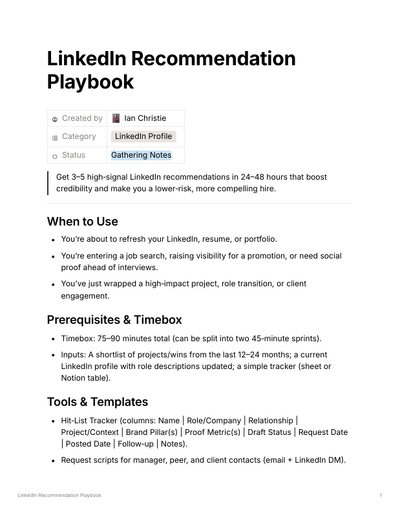
Playbook - Get High-Signal LinkedIn Recommendations Fast
Get 3–5 high‑signal LinkedIn recommendations in 24–48 hours that boost credibility and make you a lower‑risk, more compelling hire. See the downloadable PDF. When to Use You’re about to refresh your LinkedIn, resume, or portfolio. You’re entering a job search, raising visibility for a promotion, or need social proof ahead of interviews. You’ve just wrapped a high‑impact project, role transition, or client engagement. Prerequisites & Timebox Timebox: 75–90 minutes total (can be split into two 45‑minute sprints). Inputs: A shortlist of projects/wins from the last 12–24 months; a current LinkedIn profile with role descriptions updated; a simple tracker (sheet or Notion table). Tools & Templates Hit‑List Tracker (columns: Name | Role/Company | Relationship | Project/Context | Brand Pillar(s) | Proof Metric(s) | Draft Status | Request Date | Posted Date | Follow‑up | Notes). Request scripts for manager, peer, and client contacts (email + LinkedIn DM). Fill‑in‑the‑blank draft templates (manager, peer, client) so they can “tweak and post.” Nudge + Thank‑You templates and a Repurpose checklist. Steps (with checkboxes) 1) Build Your Hit List (15 min) [ ] List 8–12 potential recommenders who directly observed your work: managers; peers/cross‑functional partners; clients/vendors; project sponsors. [ ] Aim for variety + recency (last 12–36 months) and coverage across pillars. [ ] Mark Top 5 (most credible + most likely to reply this week). 3) Make the Ask the Easy Way (15–20 min) [ ] Send personalized requests (email or DM) referencing your shared project and the value of their perspective. [ ] Include this helper line: “Would it help if I drafted a short paragraph you could tweak?” [ ] Offer 2–3 focus prompts they can speak to (e.g., impact on X metric, how you led the team, how you handled constraints). [ ] If they say yes, reply with the draft + “Please edit freely—add/remove anything so it’s in your voice.” 4) Follow‑Through, Post, and Repurpose (10–15 min) [ ] Nudge gently at Day 7 if no response. [ ] Once posted, screenshot + copy the text to your asset library. [ ] Thank them [ ] Repurpose: add a short quote to resume/website; cite in interview stories; include in case studies. Scripts & Templates Request — Manager (Email) Subject: Quick favour — LinkedIn recommendation Hi [Name], I’m refreshing my LinkedIn to better reflect our work on [Project/Program]. You saw my role in [challenge] and the outcomes we achieved ([result/metric]), so your perspective would mean a lot. Would you be open to writing a short recommendation? Happy to draft a few lines you can tweak if that makes it easier. Either way—thank you for considering! Request — Peer/Partner (LinkedIn DM) Hi [Name]—I’m compiling a few short recommendations to spotlight cross‑functional wins. Would you be open to one about [project/context] (esp. [pillar])? I can send a 2–3 sentence draft to edit if that helps. Appreciate you! Request — Client (Email) Subject: Quick testimonial from our work at [ClientCo]? Hi [Name], I’m curating a few brief recommendations from recent client work. If you’re comfortable, a few lines on [engagement]—especially the impact on [business outcome/metric]—would be incredibly helpful. I can share a short draft as a starting point and you can modify freely. Draft Templates (edit freely) Manager template: “I managed [Your Name] during [Project/Period]. We faced [situation/challenge], and they [actions], resulting in [outcome/metric]. Beyond results, they [behaviour/leadership trait]. I’d happily work with them again.” Peer template: “I collaborated with [Your Name] on [Project]. They brought [specific expertise] and were instrumental in [action/outcome]. Their ability to [behaviour] made a clear difference, and I’d recommend them without hesitation.” Client template: “As [Title] at [Company], I engaged [Your Name] for [scope]. They quickly understood our context and delivered [result/metric] while [behaviour]. I would re‑engage them for similar work.” Nudge (Day 7) Hi [Name]—quick bump on the LinkedIn recommendation. No rush at all—just checking if a short draft would help. Appreciate you either way. Thank‑You Thanks so much for the recommendation, [Name]. I’m grateful for the collaboration on [project] and your time to share that perspective. Definition of Done + QA Check [ ] 3–5 new recommendations posted in the last 12 months. [ ] Coverage across manager/peer/client where possible. [ ] Each one includes specific context + action + measurable result. [ ] Collectively, they reflect your 3 brand pillars. [ ] You’ve reordered recommendations and saved copies in your asset library. [ ] No confidential data or sensitive metrics disclosed. Common Pitfalls & Fixes Generic asks → Personalize + reference the shared project; add the “I can draft for you” helper. Making them do the work → Send a concise draft; invite edits so it’s in their voice. One‑size‑fits‑all → Tailor by relationship (manager/peer/client) and by pillar. Fluff/no metrics → Replace adjectives with outcomes; include scale/impact where appropriate. Compliance concerns → Keep data non‑confidential; use ranges or qualitative impact if needed. All from one era/company → Mix recency and relationships to show breadth. No follow‑up → Calendar the Day‑7 nudge; close the loop with thanks. Repurpose Checklist [ ] Pull 1–2 sentences into your resume under a role (“What others say”). [ ] Add to case studies/portfolio. [ ] Reference in interviews (e.g., “My former client said…”). [ ] Use as social proof on landing pages (with permission).
1
Build Your Market (Ecosystem) Awareness(1) 6:45
Build Your Market (Ecosystem) Awareness
This lesson emphasizes the importance of building your market awareness by understanding industry trends, your professional role, and your specialization, transforming you into a knowledgeable and...
photo-1531280518436-9f2cc0fff88a
The Target-Based Path
Identify your Target Market If your goal is to obtain a job that fits, think quality, not quantity, of opportunities. You are better off trying to be the best candidate possible for a dozen openings rather than scatter your efforts across a hundred job applications. Your first step is to define the field, kind of organization, and kind of job you want. The beauty of having a target market in mind is that you can focus. Go back to the first article in the series, "Seven Steps to Uncovering Your Brilliance" to highlight your greatest assets. Your LiveCareer report can help you understand your career interests and work personality. Finally, refer back to the second article in this series, "In Search of Job Fit" to help you hone in on your target market. Map Your Target Market Your second step is to map your market. This involves gathering information on the companies, associations and people and how they're related. Examples of information to capture in your market map are: The market leaders - start with the obvious companies and then go deeper to identify the less visible Similar organizations - suppliers, vendors and customer organizations. Key contact people - the department manager, the executive of the group or the President, if a smaller company.Recruitment firms that specialize in the field Industry trends - what's happening in your professional area? The Internet and job boards in particular are valuable tools at this research stage. As you dig in, you'll find more sources for opportunities and be better prepared for conversations with people in the field. Diversify Your Efforts to Get the Job You Want To put yourself in the running for these "invisible" opportunities, you'll first need to find a way in. Once you're familiar with the recruiting methods and cycles of your target industry, be resourceful and use several paths to uncover opportunities. Network within your target market The benefit of having a target market focus is that there are only a certain number of players and influencers within the market. Knowing and being well thought of by these people is one of the surest paths to being a short-list candidate. Using your market map, start to approach companies and, more specifically, individuals at your target companies. There are three ways to go about this: Hot approach: Someone in your network makes a personal introduction or referral. Warm approach: Someone in your network offers you names to follow-up with. "I was meeting with John Smith at Acme Industries last week and he suggested that I give you a call. "Cold approach: Whom you contact depends on the size and complexity of the company, the degree of knowledge you have accumulated and your position. If your research has uncovered the name and title of the person you would like to work for, then they might be your target. For a smaller company, you might go directly to President or owner. Failing that, you can always approach human resources. A smart strategy is to have a reason beyond your interest in finding a job, for contacting each person. For example:You might have a question or response to news or industry trendsYou might have an expertise or solution you'd like to propose to address a particular need the company has.If you're early in your career, ask for an informational interview.
photo-1531280518436-9f2cc0fff88a
Network in Your PJs
Hate networking events? Been too busy to schedule coffee chats? I get it. Still, relationships are critical to your career growth—but I’ve noticed most of my clients spend very little time or energy networking. You know it is important and something you should do. But you’re busy. COVID-19 interrupted any networking habits you did have. And after all those Zoom/Teams meetings, you are tired. Today, I have a networking practice I highly recommend you adopt. The good news? You can do it in your PJs, during your lunch break, or between Netflix episodes. ✅ Action item: Engage with content from other professionals on LinkedIn by Commenting or Sharing. 📌 Why am I recommending this? You probably aren't doing enough networking. This is an easy addition that you can fit into your schedule. You've likely lost touch with essential relationships. If they're posting anything on LinkedIn, you can show them that you care and help them out at the same time. You can expand your network by engaging with anybody you wish. There are nearly 1 billion users on LinkedIn, and it is not worth your time to be scattered. Instead, select the relationships you need to nurture and the people aligned with your goals. No gatekeepers. You get direct 1-1 access to anyone. While there's no guarantee they'll reply, if your comment is good (see below), and if you show up repeatedly, a digital conversation might ensue, which could lead to something. The quality of your comments can demonstrate your expertise, experience, and insightfulness. The person who posted AND everyone else looking at the post can see what you wrote. Visibility! Where and on what you comment can be a powerful signal of your intent to make a career pivot or change or demonstrate your expertise. 📌 What’s the benefit to my career? Your network, and key relationships, are a success driver for your career journey. This strategy enables you to nurture existing relationships, create new relationships and earn access to people relevant to your career and business goals. It will support: Job searches, career changes and incoming opportunities Building reputation and profile Any other professional goals you may have Get some engagement with key people, and then you can turn that into a connection, potentially a call or meeting, and hopefully a relationship and future opportunities. 📌 Why does it work? People post on LinkedIn (and other platforms) for a reason. They want to get a message out. They want to build their profile. They have a business goal. No one wants crickets when they post their content. It sucks. At the same time, LinkedIn and other platforms are making it more difficult for posts to get traction. So, you are doing that person a favor by engaging with their content. If no one comments or shares a post, the author will likely get 50-200 impressions. If comments and shares start happening, that number goes up. The most powerful form of engagement is Comments (Likes are nice, but don’t do much). The more Comments (and shares), the greater the number of impressions. 📌 How to Comment - Engage Meaningfully & Regularly The core of the strategy is to become known to them, setting up a connection request and an approach for a conversation. You do that by engaging with content the company or the people post or share. If they post jobs, simply Like and, if you wish to, Share their jobs. You’re helping them out. Add meaningful comments to their posts. Be interested, interesting and helpful. Ideally, your comments add value and spark conversation. You can support their idea, add a spin, ask a question, or share a relevant resource. Ideally, engage in a conversation. Ask a follow-up question to their post. Do this right, and multiple people at your target company will recognize you. Bonus: You’re not only becoming known to the person you’re targeting. Everyone else who engages with that person’s content is seeing your contributions. That will result in visits to your profile, connection invites and more. You’ll be building your network both directly and indirectly. Approach / Connect You’ll know when the time is right to approach those you’ve interacted with. Make a Connection request. More importantly, for the people you’ve been able to engage with, you want to see if you can get a meeting. Actions: Draft a personalized request for an informational chat. Keep the ask small, like a 15 min Zoom call. Develop and ask great questions based on the context of the conversation. If career related, you might ask about their career path, their organization and advice. If the conversation is more of a get to know, you’ll share who you are and your goals and ask them to do the same. Before you sign off, ask them if there’s one person they could refer you to who might also be a good connection and conversation. Act on what you learn. Referred? Follow-up. Do they require a skill you don’t have? Look into it. Tweak your LinkedIn profile as needed. Follow up with an appropriate thank you, and don’t abandon your activity. You’ll be armed with excellent insider information and multiple connections. This strategy isn’t complicated. It does require ownership and a level of consistency over time. It won’t payout in a couple of weeks. Stick with it and sky’s the limit!
2.3 - Job Posting Best Practice & Actions
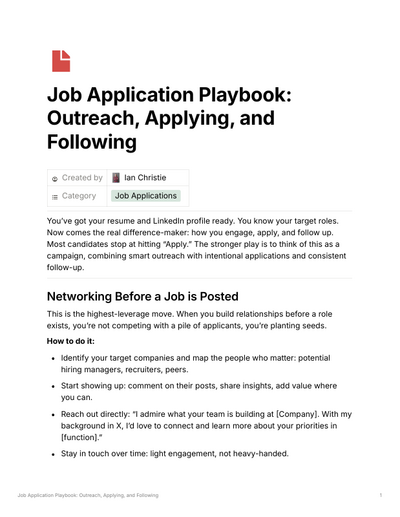
photo-1531280518436-9f2cc0fff88a
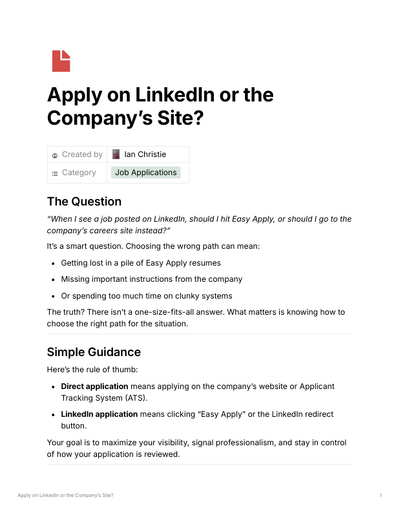
Job Postings: Apply Where You Can Win
It is a strange time in the economy. And if you are in job search mode, it can feel uncertain and scary. A client recently expressed discouragement from seeing 200+ applicants for a role posted on LinkedIn that he thought was a good fit. And you may see career advice that says to ignore job postings entirely. Here's what you need to know. First, do not be put off by a large number of applicants The number of applicants should not determine whether you apply for a posting. For more experienced, senior, and specialized roles, the 80/20 rule applies. Even 95/5. Only a small percentage of the applicants will be attractive candidates. Most of the applicants aren’t a match. Most are over-relying on a spray-and-pray approach to their “search.” I don’t want that to be you. I don’t want you to waste your time and energy. We want results. So, the caveat to point 1 is to only apply to jobs you feel you are a great fit for. Second, job postings ARE a legitimate channel for career opportunities I advise everyone not to put all their job search eggs in the same basket. There are multiple channels to career opportunities like recruiters, networks and referrals and targeting companies. Job postings are one channel and shouldn’t be your only channel. This is important because applying to job postings will work better for some than others. There are industries, roles and titles where people already in those fields can do very well with job postings. There are pockets of demand where there's enough supply, and postings work great. Candidates with matching job titles, strong brands attached to their experience and a great trajectory have an advantage. Here’s a way to test it: If, when you begin your job search, you see an abundance of fresh and interesting postings that you know you are a strong candidate for, then that’s a signal to start there. If the opposite is true, that’s a signal to double down on networks and targeted approaches. You will get stronger results when you take a selective, targeted approach to job postings backed up by strong marketing materials (resume, cover letter) and a polished and compelling LinkedIn profile. So, what should you do to optimize your job application activity? Be selective Is this a compelling opportunity, and are you a good match? You do NOT need to match all the requirements (companies often look for a unicorn). There should, however, be experience and expertise that you bring that’s central to the role's priorities. Use the 70% rule. Additionally, I want you to feel confident that you possess the personal qualities required. Follow this advice, and your conversion rate will increase. Apply strongly In some cases, create a tailored resume. And I advocate for a “why you” message that hits the key target outcomes of the role. If you are going to apply, do it well. Add a cover letter or message written in benefits language. It doesn’t have to be long. Additionally, make sure your LinkedIn profile is polished and compelling and on-target. And add the tactic below … Send a follow LinkedIn message or email to the hiring manager or recruiter Express your keen interest and highlight one or two areas of fit. Respect their process while using the message to bring your profile to their attention. (Tip: when a recruiter has hundreds of applicants to wade through and receives a polite and helpful message from someone who appears to be a fit, that person will likely get more attention.) Go beyond job postings with a proactive, multi-channel approach Postings, in most cases, SHOULD NOT be the only channel to opportunities. This passive approach has greater risk, fewer opportunities, and the most competition. The risk is greater for those people making significant pivots, with non-standard backgrounds, or in job/industry areas with fewer opportunities. So, be sure to … Leverage other channels Cultivate the relevant recruitment firms. Develop and reach out to your network. Research and target specific organizations. Job postings only represent a fraction of the opportunities available in the market. Be proactive, strategic, and intentional in your efforts for optimum results. Even better, create in advance the career capital, profile, and network power that generates a stream of ongoing opportunities and referrals for you.
Bold-Career-Job-Search-Playbook_Job-Applications-v1.2-thumb
Playbook | Outreach, Applying & Following
You’ve got your resume and LinkedIn profile ready. You know your target roles. Now comes the real difference-maker: how you engage, apply, and follow up. Most candidates stop at hitting “Apply.” The stronger play is to think of this as a campaign, combining smart outreach with intentional applications and consistent follow-up. See the downloadable PDF for this lesson. Networking Before a Job is Posted This is the highest-leverage move. When you build relationships before a role exists, you’re not competing with a pile of applicants, you’re planting seeds. How to do it: Identify your target companies and map the people who matter: potential hiring managers, recruiters, peers. Start showing up: comment on their posts, share insights, add value where you can. Reach out directly: “I admire what your team is building at [Company]. With my background in X, I’d love to connect and learn more about your priorities in [function].” Stay in touch over time: light engagement, not heavy-handed. Why it works: By the time a role opens, you’re already a known quantity. Sometimes you even help shape a role that isn’t yet posted. Networking After a Job is Posted (But Before You Apply) This is the sweet spot for many. A job is live, but you haven’t yet submitted your application. Now you can build a bridge before your resume enters the system. How to do it: Look up the hiring manager or someone on the team. Send a short, professional message: “I noticed your team is hiring for X. I’ve worked on Y and Z, which I believe align closely. Before I apply, I’d love to connect and learn what’s most important to you in this role.” If you have a warm connection, ask for an introduction. The point is not to ask for the job directly. It’s to start a conversation. Why it works: You gain context you can use in your application. And when your resume hits their system, it’s not coming in cold. Networking After You’ve Applied This is where most people give up. They apply, then sit back and wait. That’s risky, because your application can get buried. How to do it: Within 24-48 hours, reach out to someone in the company: “I just applied for [Role]. With my background in X, I’d love to contribute to [Company’s priority/initiative]. I’d be happy to share more about how I can add value.” Who: You can reach out to the person listed as the recruiting contact (recruiter, Talent Acquisition Manager (TAM)). It can also be a good idea to try and ping the actual hiring manager. Particularly if you know you’re bringing something valuable to the role and organization. Keep it short and respectful. You’re not demanding a reply, you’re signalling initiative. Use follow-up to keep the thread alive if you don’t hear back: one or two nudges over a couple weeks is fine. Why it works: A direct message can bring your application to the surface. Recruiters often check LinkedIn before pulling resumes from their ATS, so being visible can make the difference. Apply Strategically When you do hit “Apply,” make it count. Customize your resume to highlight the experience that matches the role. Use the cover letter or text box (if available) to call out 2–3 ways you’d add value in the first 90 days. Follow instructions exactly. If the posting says apply on their site, do it. Quality beats quantity: it’s better to apply well to 10 high-priority roles than scatter 100 generic applications. Think of each application as a mini pitch. Show why you’re right for this job at this company. Follow Up, Track, and Refine The most successful candidates treat their search like a system. Track every application in a simple spreadsheet: company, role, date, contacts, follow-ups, and status. Follow up 5–7 days after applying if you haven’t heard anything. A short LinkedIn note or email is enough. Review your results every couple weeks. Which roles are responding? Which outreach messages are landing? Adjust your approach. Don’t over-invest in silence. If you’ve nudged twice and heard nothing, move on. Small, consistent actions compound. One thoughtful outreach every day is more powerful than bursts of 50 applications with no follow-up. Final Word Submitting gets you in the system. Outreach gets you noticed. Follow-up keeps you moving forward. Approach each step intentionally and you’ll separate yourself from the mass of applicants who stop at clicking “Apply.”
1
Bold-Career-Job-Search-Playbook_Apply-online-or-LinkedIn-v1-thumb
Playbook | Apply on LinkedIn or Company's Site
The Question “When I see a job posted on LinkedIn, should I hit Easy Apply, or should I go to the company’s careers site instead?” It’s a smart question. Choosing the wrong path can mean: Getting lost in a pile of Easy Apply resumes Missing important instructions from the company Or spending too much time on clunky systems The truth? There isn’t a one-size-fits-all answer. What matters is knowing how to choose the right path for the situation. See the downloadable PDF. Simple Guidance Here’s the rule of thumb: Direct application means applying on the company’s website or Applicant Tracking System (ATS). LinkedIn application means clicking “Easy Apply” or the LinkedIn redirect button. Your goal is to maximize your visibility, signal professionalism, and stay in control of how your application is reviewed. Pro Tips ✅ Always read the posting carefully. If they tell you where to apply, follow those directions. ✅ Your LinkedIn profile needs to be recruiter-ready. Even if you apply direct, they will check your profile. ✅ Track your applications. Use a simple tracker (spreadsheet or CRM) to note when, where, and how you applied. ✅ Outreach beats applying. Remember: the real advantage comes from making human contact — networking, referrals, and follow-ups. Closing Thought Submitting an application gets you into the system. Reaching out and connecting gets you noticed. Be strategic about where you apply — but always pair that with follow-up and conversation. That’s what moves your candidacy forward.
1
photo-1531280518436-9f2cc0fff88a
Playbook | The Person's of Interest Strategy
KEY TAKEAWAYS | To avoid over-relying on job postings for your next professional opportunity, use this strategy to target companies, find potential future colleagues in each, become known by engaging meaningfully with their LinkedIn (or X/Twitter activity), and then position yourself for follow-up conversations. Pre-Step 1: For this strategy to work, you need to know three things: What’s your goal? Be as specific as you can about your target roles or the essential ingredients for your career change. What value are you offering? Get clear on your value proposition. What’s your “why”? Draft a statement that explains your interest. Pre-Step 2: Create a Google or Excel sheet tracker You’ll need a place to track your activities. Create a company sheet. If you want, add columns for the website, careers page, LinkedIn company page and other data (revenue, etc.) if helpful. Create a separate sheet for people. Add columns for name, company, job title, LinkedIn profile URL, location if relevant, notes, and status. Pre-Step 3: Ensure your LinkedIn profile is positioned for your target role From your headline to the about section, experience, and other sections, try to mirror role and industry keywords, have a completed professional profile, and show relevant skills and knowledge. Step 1: Create a Top 10-20 list of target companies Write down the names of organizations you think you’d want to work with AND could bring real value to. Some of these may be known to you. You’ll likely be doing some research. Hints: The number is not as significant as your selection of these organizations. You can add to the list as you go. If you’re stuck at 5, start there and return to it. Who is your market? Big names are great, but be open to uncovering the less-known gems. Actions: Enter the list on your company sheet Visit the company page for the company. Follow them to get access to their posts in your feed. Step 2: Identify 10 relevant LinkedIn profiles per company The goal here is to find the actual people you’d work with - hiring executive/manager, colleagues, cross-departmental peers, and HR/Recruiters. If the organization’s size doesn’t warrant that number, adjust down. If you spot a profile of someone who left the company in the last year and came from the relevant departments, add it to your list. They can be valuable as well. Actions: Start filling out the sheet as you do your research. If you have existing connections, make a note of those. Do not try to Connect with the rest. Instead, you want to follow them. If someone has “Creator” status on LinkedIn, you can Follow them (also click the Bell icon to be notified when they post). Otherwise, you’ll use their profile URL in the sheet to visit periodically. Step 3: Engage meaningfully and regularly The core of the strategy is to become known to them, setting up a connection request and an approach for a conversation. You do that by engaging with content the company or the people post or share. Not all of the people on your list will be posting. Actions (applies to both Company pages and people): If they post jobs, simply Like and, if you wish to, Share their jobs. You’re helping them out. Add meaningful comments to their posts. Be interested, interesting and helpful. Ideally, engage in a conversation. Ask a follow-up question to their post. Do this right, and multiple people at your target company will recognize you, including those not on your list. Step 4: Approach / Connect You’ll know when the time is right to approach those you’ve interacted with. Make a Connection request. More importantly, for the people you’ve been able to engage with, you want to see if you can get a meeting. Actions: For each company, please write a brief fan story that explains why they’re on your list. Draft a personalized request for an informational chat. You can be upfront about your interest in their company. However, assure them you’re not asking about jobs. Keep the ask small, like a 15 min Zoom call. Develop and ask great questions about their career path and informed questions about the department and organization. Before you sign off, ask them if there’s one person they could refer you to who might also be a good connection and conversation. Act on what you learn. Referred? Follow-up. Do they require a skill you don’t have? Look into it. Tweak your LinkedIn profile as needed. If you learn that this isn’t the company for you, take it off the list. Step 5: Thank them and stay in touch Follow up with an appropriate thank you, and don’t abandon your activity. You’ll be armed with excellent insider information and multiple connections if an appropriate job posting arises. Why it works The People of Influence strategy makes your networking tangible. You know you’re supposed to do more of it, but that’s not an instruction. This is a plan you can operationalize. It reduces your reliance on job postings. If you work the system, make a great impression and a relevant role gets posted, you’ll have an inside track. It plants seeds that could bear fruit down the road. You’ll likely engage with people not on your target list who become valuable contacts and even potential places for great work assignments. This strategy isn’t complicated. It does require ownership and a level of consistency over time. It won’t payout in a couple of weeks. Stick with it and sky’s the limit!
2.3 - Additional Resources
Bold-Career_Playbook_Beginner-s-Guide-to-Boolean-Search-thumb
Playbook | Boolean Search for Job Search & Networking
Beginner’s Guide to Boolean Search for Job Search & Networking (Unlock better results on LinkedIn, job boards, and Google) The Problem Most professionals type simple words into LinkedIn or a job board search bar and hope for the best. The problem? Search engines are literal. If you don’t give them the right instructions, they’ll either show you too much (irrelevant noise) or too little (missed opportunities). That’s where Boolean search comes in. It’s a way of using special operators — AND, OR, NOT, quotation marks, and parentheses — to get laser-focused results. 1. The Core Boolean Operators Here’s what you need to know (and nothing more): AND → Narrows your search (must include all terms). Example: ("project manager" AND healthcare) OR → Broadens your search (any of the terms). Example: ("VP Sales" OR "Head of Sales" OR "Sales Director") NOT / - → Excludes terms. Example: (marketing AND manager NOT "digital marketing") "Quotes" → Exact phrase. Example: "supply chain analyst" (Parentheses) → Groups logic together. Example: (consultant OR advisor) AND ("financial services") 2. Where to Use Boolean in Your Job Search LinkedIn People Search: Find hiring managers, recruiters, or alumni. Example: ("Talent Acquisition" OR Recruiter) AND ("Microsoft") LinkedIn Jobs Search: Expand titles, filter industries. Example: (Director OR "Head of") AND ("operations" AND logistics) Job Boards: Refine roles across Indeed, Glassdoor, etc. Example: ("business development" AND SaaS) NOT internship Google Search: Surface hidden opportunities. Example: site:linkedin.com/in ("supply chain" AND "Vancouver") 3. Quick Wins for Networking Find decision makers: ("VP" OR "Director") AND ("Product Management") AND ("Toronto") Uncover alumni: ("University of British Columbia" AND "MBA") AND (alumni OR graduate) Identify recruiters in your niche: ("Recruiter" OR "Talent Acquisition") AND ("MedTech") 4. Common Mistakes to Avoid ❌ Typing only one job title (you’ll miss variations). ❌ Forgetting quotes around multi-word titles. ❌ Overusing NOT (you might accidentally filter out good leads). ❌ Making the search too complex (start simple). 5. Next Steps Experiment: Start with one or two operators and build up. Save your searches: On LinkedIn or job boards, save searches for alerts. Think like a recruiter: They use Boolean daily to find you. You can flip it to find them. 👉 Pro tip for clients: Build a mini “Boolean Library” in Notion/Excel with your top titles, target companies, and search strings. Copy/paste as needed — it saves hours.
1
2.4 - Recruiter Best Practice & Actions
photo-1531280518436-9f2cc0fff88a
3rd Party Recruiter - Rules of Engagement (Read This First)
While search and recruitment firms play an important role in some industries, you don't necessarily want to rely on them for your next job. Though they need the right people to fill their openings, they work for the hiring company, not the job seeker. Tap into this resource by focusing on local players and specialists who operate in your target market. Approaching them via a referral can be an effective introduction or apply to a job they've posted if it appears to be a fit. You can also introduce yourself as a potential candidate for future openings by sending a cover letter, resume and follow-up with a telephone call. Before you send a single message, internalize these principles. The scripts in the next lession will fail if you ignore the mindset behind them. How Recruiters Think Their client is the hiring organization, not you. Executive recruiters and search consultants are paid by companies to find the best talent. They are under no obligation to help you. Every message you send should reflect that you understand this. They are evaluating you from the first word. Your DM is an audition. How you communicate signals whether you understand the game, whether you'd embarrass them in front of a client, and whether you're worth their time. They value sources as much as candidates. A recruiter's currency is access to talent and market intelligence. If you can offer referrals, perspective, or insight into your industry, you become valuable to them regardless of whether they have a role for you today. The Mindset Rules Don't be needy. The biggest rookie mistake is behaving like the firm exists to help you find a job. They can smell desperation. Position yourself for a long-term relationship, not a transaction. Don't be cocky. You are one prospective candidate in a daily parade of prospective candidates. Confident humility is the way to go. A demonstrated ability to be self-aware doesn't hurt either. Be selective, not scattered. Savvy candidates communicate that they are being choosy about who they talk to and what opportunities they pursue. This signals value and "freshness" in the market. Be useful. Offer perspective, advice, insight, and leads to names. When a recruiter asks "who can do this job?" and your name comes up, you win. When YOU can answer that question for them about others, you win twice. Dig the well before you're thirsty. Build relationships when you don't need them. The real reward is repeated access to opportunities over the course of your career. Appreciate the role they play. Search professionals often don't feel appreciated by candidates, clients, or the broader industry. Showing genuine respect for what they do creates instant goodwill. Freshness: The Unspoken Factor There is an implicit "freshness factor" in how recruiters perceive candidates: Most fresh: You are employed and just starting to look. Maximum market value. Next level: You are employed with a target exit date. Then: You have just left and just entered the market. Declining from there: The longer you've been searching, the more assumptions are made about your desirability. What to do about it: If you are still employed, say so explicitly in your message. If you just came onto the market, move quickly and communicate that. Use language that conveys selectivity: "exploring strategically," "being intentional about my next chapter," "beginning to think about what's next." Stay busy. Consulting work, advisory roles, or board involvement keeps you "employed" in the eyes of the market. What NOT to Do 🚫 These are the fastest ways to get ignored or damage your reputation with a recruiter: Don't send your resume unsolicited without context. A resume with no message or a one-line "please see attached" is lazy and signals you're mass-blasting. Don't write a novel. If your first message is longer than a phone screen, they won't read it. Keep it under 150 words. Don't ask "do you have any roles for me?" This signals you don't understand how search works. They work on specific mandates, not a job board. Don't follow up aggressively. One follow-up after 7-10 days is fine. Two or more without a response and you're in stalker territory. Move on and circle back in 3-6 months with something new to share. Don't badmouth your current or former employer. Even subtly. It raises red flags immediately. Don't be invisible. If a recruiter searches your name and finds nothing — no LinkedIn presence, no industry footprint, no evidence of your work — they only have your word to go on. The more people who can say "yeah, they're excellent," the better. Don't confuse retained and contingent recruiters. Retained search consultants (the big firms, exclusive mandates, senior-level searches) and contingent recruiters (paid on placement, often non-exclusive) operate very differently. Tailor your expectations accordingly. With contingent recruiters, be more cautious — they may not have an exclusive on the role and may know less about the specifics. Don't treat this as your primary job search strategy. Recruiter outreach should be ONE channel in your job search, not the whole thing. Spend no more than 15-20% of your job search time on recruiter outreach. The rest should go to networking, direct applications, and building visibility. The Long Game: Building Recruiter Relationships Over Time The real payoff from recruiter relationships isn't the first message — it's what happens over months and years. Here's how to maintain and deepen these connections: Be a reference. Volunteer to be a reference for former colleagues who are worthy. When you give a thoughtful, honest reference, the recruiter conducting that check notices YOU. Share market intelligence. When you see a trend, a major hire, or a leadership shake-up in your industry, share it with recruiters you've connected with. A quick "thought you'd find this interesting" message keeps you top of mind. Respond when they call. Even if the opportunity isn't right for you. Return the call. Qualify the opportunity. If it's not a fit, say so and tell them why. Then offer to help by suggesting people who might be right. This is how long-term relationships are built. Stay in touch on a 3-6 month cadence. A brief check-in, a congratulations on a big placement, or sharing an article about your industry keeps the relationship warm without being pushy. Cultivate the whole pyramid. Search firms have partners, consultants, associates, and researchers. The junior people do most of the candidate sourcing work. Every person at the firm can be your ally. Treat researchers and associates with the same respect you'd give a partner. 💡 Remember: Developing relationships with search firms and their professionals is best viewed as a long-term investment. Yes, you can have a short-term payoff. But the real reward for nurturing those relationships is repeated access to opportunities over the course of your career — and, if you're fortunate, relationships with the most connected and influential people in your industry.
photo-1531280518436-9f2cc0fff88a
Playbook | 3rd Party Recruiter Networking Scripts
LinkedIn DM Playbook: How to Approach Executive & 3rd Party Recruiters A fill-in-the-blank script framework for introducing yourself to headhunters, retained search consultants, and contingent recruiters on LinkedIn. Built for senior managers, directors, VPs, and executives navigating today's hyper-competitive market. Before You Send: Delivery Checklist [ ] Is this the right recruiter? Have you confirmed they specialize in your industry, function, level, or geography? Sending a generic message to the wrong recruiter wastes both your time. [ ] Is your LinkedIn profile ready? Recruiters will check your profile immediately. If your headline, summary, and experience don't tell a clear story in 10 seconds, fix that first. [ ] Are you using the right channel? LinkedIn DMs from non-connections go to the "Other" inbox and are often invisible. Best practice: send a connection request with a note (Script 3 below), then follow up with a longer DM (Script 8) once accepted. Use InMail only if you have Premium and the recruiter is clearly active on LinkedIn. [ ] Have you personalized it? If the recruiter can tell you copied and pasted this to 50 people, it's dead on arrival. Reference their specialty, a recent post, a mutual connection, or something specific. [ ] Is it short enough? Aim for 75-150 words. Recruiters scan, they don't read essays. Every sentence must earn its place. [ ] Does it have one clear CTA? Don't give them three things to do. Ask one question or make one request. How to Use These Scripts Each script is a component framework with fill-in-the-blank fields marked in [brackets]. Every script follows a 4-part anatomy: The Hook — Why you're reaching out to them specifically The Positioning Line — Who you are in 1-2 lines (level + function + industry + signal of value) The Intent Signal — What you're looking for, without being needy The CTA — One clear, low-friction ask ⚠️ Important: These are frameworks, not copy-paste templates. The more you personalize, the better your response rate. Generic messages get ignored. In 2026, AI-generated outreach is everywhere, so authenticity and specificity are your competitive edge. Script Quick Reference CATEGORY 1: Cold Introduction (No Referral) These are the hardest messages to land. You have no warm connection and the recruiter doesn't know you. Your goal is to stand out from the avalanche of "I'm looking for a job" messages they receive daily. Lead with specificity, signal that you understand how the game works, and keep it tight. Script 1: The Specialist Match Use when the recruiter's practice or firm specializes in your industry, function, or level. Works for: All levels — Senior Managers through C-Suite Hi [Recruiter First Name], I noticed your practice focuses on [their specialty — e.g., senior finance leadership / supply chain executives / technology sector searches]. That's my world. I'm a [Your Title] with [X years] in [your industry/function], currently [leading / overseeing / driving] [brief scope — e.g., a $200M P&L / enterprise digital transformation / commercial operations for a mid-market manufacturing company]. I'm not in urgent need — I'm being intentional about my next chapter and building relationships with recruiters who specialize in [their niche]. I'd welcome the chance to introduce my profile for any current or future searches where there's a fit. Happy to be a resource on [industry/function] talent as well. Would a brief intro call make sense, or would you prefer I send my resume for your files? Why it works: Leads with their specialty, not your need "Not in urgent need" = freshness signal "Happy to be a resource" = offering to be a source (high value) Two-option CTA reduces friction and lets them choose their comfort level "For your files" shows you understand that search firms run on databases Customization tips: Research the recruiter's LinkedIn headline, recent posts, and firm website to confirm their specialty before writing Replace the scope line with your strongest, most concrete differentiator — numbers, outcomes, scale Script 2: The Market Mover Use when you are currently employed and exploring proactively. Maximum freshness positioning. Works for: All levels — Senior Managers through C-Suite Hi [Recruiter First Name], I'm reaching out to a small number of recruiters active in the [industry / function / geography] space as I begin exploring what's next. Quick snapshot: [Your Title] at [Company name or descriptor — e.g., a top-5 Canadian bank / a PE-backed industrial platform / a global SaaS company], [leading / responsible for] [brief scope]. Known for [1-2 differentiators — e.g., building high-performance commercial teams / turning around underperforming divisions / scaling operations through acquisition integration]. I'm still in my current role and being selective about what I'd consider moving for. If my profile lines up with anything on your desk now or down the road, I'd welcome a conversation. What's the best way to get on your radar? Why it works: "Small number of recruiters" = selective, not desperate "Still in my current role" = maximum freshness "Being selective about what I'd consider" = confident, not needy "What's the best way" defers to their preferred process Customization tips: If you can name the company, do it — brand recognition helps. If discretion is needed, use a descriptor ("a Fortune 500 retailer") "Known for" should be what others would say about you, not just what you think. Pick differentiators that signal you're a top performer, not just competent ⚠️ Caution for job seekers who are NOT currently employed: Do not use this script if you've already left your role. The "still in my current role" line is the engine of this message. Use Script 1 or Script 8 instead, and apply the freshness management tactics from the Rules of Engagement above. Script 3: The Connection Request Note Use as the first touch when sending a LinkedIn connection request. This is limited to approximately 300 characters, so it must be ultra-concise. Works for: All levels Hi [Recruiter First Name] — [Your Title] in [industry] with a track record in [1 key strength — e.g., scaling tech teams / financial transformation / commercial growth]. Exploring my next move strategically and connecting with recruiters in [their specialty]. Would welcome being on your radar for relevant searches. Why it works: Fits the connection request character limit Establishes who you are, what you do, and why you're reaching out in three lines "Strategically" and "relevant" signal selectivity 🔴 Critical: This script is a door-opener only. It should ALWAYS be followed by Script 8 (The Follow-Up After Connection) once the recruiter accepts. Do not treat this as a standalone message — it's too short to build a real impression on its own. Customization tips: Cut ruthlessly. Every character counts. Drop articles ("a", "the") if needed Your "1 key strength" should be the single thing most likely to make this recruiter think "I might need this person" CATEGORY 2: Warm Introduction (Referral or Shared Context) Referrals are the single most powerful way to reach a recruiter. Bar none. If you have any kind of connection — direct referral, mutual contact, shared alumni network, shared industry event — use it. These scripts leverage that warmth. Script 4: The Named Referral Use when someone in your network directly knows the recruiter and has agreed to let you use their name. Works for: All levels Hi [Recruiter First Name], [Referrer's Full Name] suggested I reach out. [He/She/They] mentioned you as someone who [specific context — e.g., knows the consumer goods space well / handles senior-level searches in financial services / is one of the best in the market for operations leadership]. I'm a [Your Title] with [X years] in [industry/function], currently [brief scope — e.g., leading North American commercial operations for a $500M division / heading product management for a high-growth fintech]. I'm [exploring a strategic move into / beginning to think about] [target — e.g., a broader leadership role / a high-growth environment / a CEO or GM opportunity], and [Referrer's First Name] thought there might be alignment with your practice. Would you have 15 minutes for a brief introduction? I'm happy to work around your schedule. Why it works: Referral name up front grabs immediate attention — this is the #1 factor in whether they read the rest Uses the word "practice" (not "job listings") — signals you understand their world Specific CTA with time commitment ("15 minutes") makes it easy to say yes "Work around your schedule" = you respect their time Customization tips: Always confirm with your referrer that they're comfortable being named, and ask them exactly how the recruiter would know them (client? candidate? colleague?) If the referrer can send a separate intro message or email first, that's even more powerful. A "double touch" dramatically increases response rate The more specific you can be about what the referrer said about this recruiter, the more credible the message Script 5: The Mutual Connection Bridge Use when you share a LinkedIn connection with the recruiter but don't have a direct referral. Also works for shared context: same alma mater, same conference, same industry association. Works for: All levels Hi [Recruiter First Name], I noticed we're both connected to [Mutual Connection Name] [optional context — e.g., we worked together at Company X / served on the same industry board / were in the same MBA cohort]. That prompted me to look at your profile, and your work in [their specialty] is right in my space. I'm a [Your Title] currently [brief scope — e.g., leading supply chain transformation for a national retailer / running a 200-person engineering organization]. I'm beginning to think about my next move and building relationships with recruiters who really know the [industry / function / market]. Would you be open to a brief conversation? I'd value your perspective on the market as much as anything. Why it works: The mutual connection provides a reason to reach out that isn't "I need a job" "Value your perspective" = appreciating the role they play and asking for something they enjoy giving "Beginning to think about" = early stage, not desperate Low pressure, relationship-oriented Customization tips: If you're going to name-drop a mutual connection, make sure you actually have a real relationship with that person. Recruiters may check "Your perspective on the market" is a powerful phrase because it positions the recruiter as an expert and advisor, which is how they like to be seen CATEGORY 3: Engagement-First & Follow-Up Scripts These scripts are for candidates who want to build the relationship before making a direct ask. This is the "dig the well before you're thirsty" approach — and it works. Script 6: The Content Engage to DM Use when you've been commenting on or engaging with the recruiter's LinkedIn posts and are now ready to take the relationship to a direct message. Works for: All levels Hi [Recruiter First Name], I've been following your posts on [topic — e.g., leadership hiring trends / what makes candidates stand out in executive search / the state of the CFO market]. Your take on [reference a specific post or insight — e.g., why passive candidates outperform active ones / the importance of executive presence in interviews] really resonated. Quick intro: I'm a [Your Title] in [industry], [1 brief differentiator — e.g., with a track record of scaling commercial teams across APAC / known for leading complex integrations post-M&A]. I wanted to connect more directly. If you're ever working on a search in [function / industry / level], I'd welcome the chance to be considered — or to help as a sounding board on talent in the space. I appreciate what you share. It's clearly informed by real search experience. Why it works: Proves you've actually engaged with their content — this is NOT a mass message Offers to be a sounding board (source value) The closing compliment is genuine and specific, not flattery Works even if you've only commented on 2-3 posts — that's enough to reference Customization tips: Before sending, go comment thoughtfully on 2-3 of their recent posts over 1-2 weeks. This creates a "warm" feeling before the DM lands Reference a SPECIFIC post, not a vague topic. "Your post last week about why search committees should challenge their own assumptions" is 10x better than "your leadership content" Script 7: The Source-First Approach Use when you can genuinely offer market intelligence, referrals, or sourcing help. This is the most sophisticated play — leading with value before you ever ask for anything. ⚠️ Level: This script works best for VPs, SVPs, C-Suite, and Senior Directors who have genuine hiring authority, deep industry networks, and real market knowledge to share. If you're at a level where you don't yet have a network of peers a recruiter would want to tap into, use Scripts 1, 2, or 6 instead. Using this script without the substance to back it up will backfire. Hi [Recruiter First Name], I lead [function] at [Company/descriptor] and have a deep network in [industry / function / geography]. I'm always happy to help strong recruiters with sourcing when I can — if you're ever working on a [level — e.g., VP / Director / C-level] search in this space, feel free to reach out. I know who's strong. Separately, I'm beginning to think about my own next chapter and would value having a relationship with someone in your space. No rush on my end — just planting seeds. Open to connecting? Why it works: Leads with giving, not asking — the most powerful positioning move in the recruiting world "I know who's strong" signals that YOU are the kind of industry insider recruiters cultivate "Planting seeds" = long-term orientation, zero desperation The separation of "I can help you" and "I'm also exploring" is deliberate. It prevents the message from feeling transactional Customization tips: Only use this if you can genuinely deliver. If a recruiter takes you up on the sourcing offer and you come up empty, you've damaged your credibility Consider following up in 2-3 months with an actual referral or market insight, even if they haven't responded. That consistency builds real trust over time Script 8: The Follow-Up After Connection Accepted Use after a recruiter has accepted your LinkedIn connection request. This is the natural second step after Script 3, or after any connection that didn't include a substantive first message. Works for: All levels Hi [Recruiter First Name] — thanks for connecting. Wanted to give you a bit more context: I'm a [Your Title] with [X years] across [industries / companies / functions — e.g., consumer packaged goods and retail / B2B technology and SaaS / financial services and insurance], most recently [current or most recent scope — e.g., leading a 150-person commercial organization / driving $80M in new business development / overseeing enterprise risk for a top-20 insurer]. I'm [selectively exploring / beginning to think about] my next role and building relationships with recruiters who work in [their specialty]. If my background lines up with anything you're working on — now or later — I'd welcome a conversation. Happy to send my resume if it would be useful for your files. What works best? Why it works: Doesn't waste the connection — many candidates connect and then go silent "For your files" shows you understand that search firms maintain databases and that getting into their system has long-term value "What works best?" defers to their process and is an easy CTA to respond to "Now or later" signals patience and a long-term view Customization tips: Send this within 24-48 hours of the connection being accepted. Don't let it go cold If you have a well-formatted, ATS-friendly resume ready, mention it. Recruiters want to get strong profiles into their system quickly Script 9: The Re-Engagement Use when you've had a previous interaction with a recruiter — a past search, a phone call, a referral from years ago — and want to reconnect. Works for: All levels Hi [Recruiter First Name], We [spoke / connected / crossed paths] [timeframe — e.g., a couple of years ago / back in 2024 / earlier in my career] regarding [context — e.g., a VP Operations search at Company X / a role you were filling in the consumer space / an introduction through Mutual Contact Name]. I wanted to reconnect and update you on where I am. Since then, I've [moved into / been promoted to / taken on] [current role and scope — e.g., SVP of Commercial at a $1.2B industrial distributor / VP Engineering leading a 300-person global team]. I'm now at a point where I'm [selectively open to / actively exploring] the right next opportunity. Would love to re-introduce myself and hear what you're seeing in the market. Do you have 15 minutes in the coming weeks? Why it works: Reminds them of the connection — search firms keep records, and they may have a file on you "Update you on where I am" = managing freshness and showing career progression Specific, time-bound CTA ("15 minutes in the coming weeks") is easy to say yes to "What you're seeing in the market" positions the conversation as mutually valuable, not one-directional Customization tips: If you remember the name of the search or the specific role, include it. It helps them look you up in their system If you were a short-list candidate on a past search but didn't get the role, mention that. Search professionals love to revisit past candidates who performed well — you've already been vetted
photo-1531280518436-9f2cc0fff88a
Six Reasons Executive Recruiters Will Talk to You
What are the key reasons executive search firms and other 3rd party employer-paid recruitment agencies will pay attention to you? The fundamental starting point is that these firms and their individual partners, associates, or support staff, are under no inherent obligation to give you any of their time. They owe you nothing. The client of the search firm is the hiring organization. That is rule one. However, rule two is that the recruiting firms need candidates that FIT their current and future assignments in order to do their job. As a result, search firms can be highly selective about with who they invest their time. So, how do you get their attention? By analyzing the key reasons or circumstances under which a headhunter might talk to you, you can devise your approach strategies accordingly. Here are the top reasons: Reason #1: You are a clear and strong candidate for a current search assignment This sounds obvious, but that period of time when the recruiter is hunting for suitable candidates is a time when the doors are theoretically open. Whether you have applied to an ad, sent in a blind resume, have been referred, or called, you might get their attention if you are a strong match for an assignment they are currently working on. Note: A search firm gets paid to attract people who are among the best in their field, not those just able to do the job. This fact of life is at the root of a lot of frustration among candidates regarding search firm unresponsiveness. Action item: If you are going to apply to one of their openings, apply a laser focus to the opportunity at hand. Show them “why you.” Reason #2: You fit with their specialty & appear to have a pedigree that seems “placeable” If they have the time, you may get their attention if your profession and industry are closely aligned with the kind of work they do, and your career trajectory is impressive. They will judge how placeable you are, that is, how likely it is that one of their clients would want to hire you. If there is a strong fit, then yes, they may make time for you. Action item: Target the specialist firms, and specialist practitioners within general firms. Reason #3: You come referred by someone important The world of executive search and recruitment is about relationships and exchange of information. Yes, ads are posted, but the ads often serve as backups. The real work occurs on the phones, speaking with people in their networks about who is good and who is ready to take on the challenge at hand. Referrals. That's how it works. So, search professionals tend to be highly attuned to incoming referrals from their network. The referrers may be current and past clients, industry experts, or former candidates. The later category is tricky. The power of the referral in this case really depends on the level of relationship that candidate had with the search firm. Action item: Work your networks. Ask for referrals. If at all possible, lay-up an introduction rather than going in cold. Reason #4: You are someone they want to get to know If the search firm partner or associate concludes that you are a player, someone who might hire them to do search work in the future; someone who is well respected in the industry; someone with a big and powerful network, then they may be eager to start a relationship with you. Being an up-and-comer can also be an attractor. You may not, in their eyes, be ready today, but talking to you now may in fact be a good investment of time on their part. Action item: Don’t be invisible. Seed your field so that your name comes up when key people are asked “who can do this job.” Reason #5: You are a file builder during slower times The fewer active assignments they have, the more time there is to fill their pipeline. Yes, they will be out looking for new clients, but it is also a time to catch-up on meeting new candidates. In a slower market, they are likely to be a little more open in who they talk to. Action item: Don’t forget the slow cycles. Try and approach before you need to find a job. Word your approach as one of “getting to know for future potential assignments.” Reason #6: You represent a valuable contact for a more junior headhunter You might not be able to get a partner or senior consultant's attention, but you may be able to with an associate or researcher. Don't underestimate the power of these folks to insert you into the search firm's active system and assignments. And, they need to build their career with strong, relevant and productive relationships. It could be you. Action item: If contacted by someone at this level, treat him or her seriously. If you can’t reach the partner, approach the researcher or associate. That's it. Yes, you may get in because you catch someone on a good day, and they feel like helping, but don't count on it. As a rule, these are the only instances when you can get an audience with a search firm. Understanding these reasons now arms you with potential strategies. Good hunting
photo-1531280518436-9f2cc0fff88a
12 Ways to Be Ready When the Recruiter Calls
As a leader who cares about the health of their career, you need relationships with reputable executive recruiters (aka headhunters). The executive search or recruiting firms looking for management-level to executive-level talent can be an important channel of opportunity. Here are 12 ways to demonstrate credibility and build a relationship with a headhunter. First, search professionals come in a lot of shapes and sizes. One thing they ALL have in common however, is their constant need to identify and build relationships with relevant quality talent so that they can deliver on their client mandates. So when you receive that LinkedIn message, email or phone call, how should you play it? Here are 12 behaviours to model for when you have the opportunity to talk to an executive recruiter. 1. Don’t be needy One of the biggest rookie mistakes is behaving like the firm is there to help you find a job, and that given that you need a job, they should help you now. Wrong. The search firm is under no obligation to help you whatsoever. Try not to project an aura of neediness. (Hint: They can smell it.) Position yourself for the long-haul and you will do better. 2. Don’t be cocky Don’t be too full of yourself. You are just one potential candidate in a daily parade of prospective candidates. Don’t be a peacock and puff yourself up. Confident humility is the way to go. A demonstrated ability to laugh at yourself doesn’t hurt either. 3. Tell them you aren’t a fit Let them know when the opportunity described is not a fit for you and explain why. Part of building your credibility is being strong about what you are and what you aren’t, what is a fit, and what isn’t. They respect that kind of candour. And you haven’t wasted their time. 4. Ask insightful questions about the opportunity The headhunter will give you a brief description of the opportunity they werehired to fill. One of the best ways to capture their interest is to ask questions that cut to the heart of the job assignment and demonstrate that you get the industry / market and challenge / opportunity of this assignment. 5. Deliver tangible soundbites to earn trust and attract interest The executive recruiter (if they are good) is not looking to make a hire on the first phone call. Their task is to determine if there is enough fit and mutual interest to take it to the next step. To do that, you are going to need to reveal things from your experience that are relevant to the search. Be as specific and tangible as you can without breaching confidentiality boundaries. 6. Appreciate their role in the hiring equation I am going to let you in on a secret. Recruiters often don’t feel the love from their candidates and clients. It is the nature of the business. Show them that you think they do a pretty cool job in identifying and attracting just the right talent for key senior jobs. They will notice. One tangible way of doing this is to respond to their message or return their call promptly. 7. Be a connector How do you build relationships? You give. What can you give an executive recruiter who calls: Perspective Advice Insight And leads to names It is the way the game is played at the senior level. Once you make contact with a reputable search person, close your conversation by offering to help on current or future searches. Sources, i.e. peer networks, are the primary means of finding quality talent. When the phone rings, go out of your way to assist, and bingo, you are in. Remember that they aren’t asking you who is looking for a job. They are more interested in who would be the best candidate for this job. There is a difference. You can and should refer quality candidates to them. The key word is quality. 8. Have a flexible focus In general, the firms like candidates who understand their value in the market. At the same time, they love candidates who aren’t too rigid about what opportunities they will consider. Search assignments come in all sizes, and they often need a candidate with an out-of-the-box openness to get them filled. 9. Make them look good in front of their clients Short of being the successful candidate, the next best outcome is to be on the short-list. Search professionals love to revisit past candidates, providing they have been an asset in past assignments, and not an embarrassment. If you make the short-list, impress the client, but lose out to another candidate, then chances are, you have just made a friend with the search partner. You will be called again. 10. Cultivate the pyramid The established search firms aren’t much different from law firm or accounting firms. A few partners are supported by a consultants, associates, researchers and assistants. The junior folks do most of the work of candidate generation. Each one of these folks can be your ally, or enemy. 11. Make them comfortable with tactful name-dropping How do you make a search professional nervous? Be invisible. If they haven’t heard of you and more to the point, if their sources haven’t heard of you, then for the moment, they only have your word to go on. Get known in your industry or market. You don’t have to be famous, but the more people who can say, “Joe, yeah, Joe is fantastic” the better. Your LinkedIn profile and network yield important clues about your connectedness in the tribe. 12. Demonstrate polish and class All things being equal, extra points will go to you as a candidate if you can: articulate your story in a compelling way both informally and under pressure in interview situations show finesse in your interactions, both verbally and in writing and show a high level of professionalism throughout the process Developing a relationship with recruiters is best looked at in the long-term. The real reward for nurturing those relationships is repeated access to information and opportunities over the course of your career. And, if you are lucky, relationships with interesting, connected players in your industry.
Your Professional Story & Messaging
cbb6ecf3-3e2c-4496-b448-bd8ca3e66837-hd(2) 6:30
Leverage the Power of Story
Objective: In this lesson, we are tapping into story to better identify, highlight and prove your professional capabilities. We also leverage story to create a narrative of where we've been and where we are going - a powerful tool.  Instructions:  Watch the video Add a comment and discuss below. Proceed to the next lesson. 
QEJbUHSBQgS7W9oO1E1Y_M5_c_Behavioural_Questions_part_2-hd(1) 10:56
Learn a Story Framework
Use a Story Framework The formula is...C.A.R. Challenge What were you challenged with? Hired to do? Assigned to do? A job. A project. An opportunity. A crisis. A problem. A performance objective. Actions What did you do in response to this challenge? Use action verbs as much as possible. Results What was the result of your actions? Connect it back to the Challenge. Be as objective as possible. Quantifiable and measurable are best ($ saved, % improvement, etc.). When that isn’t possible, be as tangible as possible (e.g. “saved customer relationship and they continued to do business with us”, “turned an antagonistic relationship into a productive one”) Alternative Formulas S.T.A.R. | Situation. Task. Action. Result. S.H.A.R.E. | Situation. Hindrance. Actions. Results. Evaluate
photo-1531280518436-9f2cc0fff88a
Homework 1 - Craft Your Career Story
Instructions Refer to Homework 1 in the workbook for this module. It is available for download below in this lesson. Start with the Craft Your Career Story exercise. This is optional but recommended. Use the information below to help.  Then, work on your career direction story. See the information below for context on this.  Craft Your Career Story [Optional exercise] Rules: Your experience has helped to mold you. Approach this exercise with an appreciative mind, not a critical mind. If you’ve made mistakes, or have regrets, notice them, hold them lightly, and be grateful for that learning opportunity. Remember that your journey involves roads and paths (well-trodden and less so), directional choices, stay points, people, adventures, hard lessons, joyful experiences, stories to tell and next stages of the journey. Also, remember that it is YOUR journey. Prompts to Aid You: What’s a good top-level title for your story? If you looked at your overall professional life as STAGES or phases, what would each be? You can use the stages to fill out your story (or not) If so, how would you describe the “theme” of each stage? The degree of safety vs adventure Identify and appreciate the learnings (including hard lessons), acquired (skills, knowledge, experience, people…) Most rewarding, intense experiences Things you’re most proud of Did you have original intent or dream when you first started? Over time, have you developed a “destination”, a goal? (Note: Not suggesting that you need one) What have been your primary drivers for moving forward? Why are you on this journey and why have you made the choices you’ve made? Is money/providing for yourself the sole driver, or are there others? Think about those key moments along the journey (typically choices about yes/no, this direction or that, this experience or that…). What pattern emerges? Now, think about the key encounters you’ve had on the journey. The people who have influenced you or your direction, the people who helped you, or challenged you to work harder. Who has made a difference? How would you describe your approach to the road and journey? Did you look for the first safe place to settle and hope that you didn’t need to move again? Have you been a wanderer? Or navigating towards a focused destination? Or somewhere in between? Craft Your Next Chapter Story Inevitably, you are going to be asked in some form or another, "what do you want" or "what's your goal". In addition being able to show you have direction, (which is powerful), having a vision and a strong "why" are powerful drivers to keep you on course and give you energy when you experience setbacks.  Use this opportunity to capture where you are going.  How Much of "You" Should Go into Your Career Story? I get to work with fascinating and inspiring clients. And a lot of what we do together as part of personal branding is making sense of the various threads of their stories. How they got here. What they offer. And where they’re going. I was meeting with a client this week who in addition to having built up a not-for-profit, has both an unusual early professional background and a rich, extra-curricular artistic life. The question: How much of HER can and should go into her personal brand? We’ve been taught to be professional, to conform to resume guidelines, safe interview answers, and relatively bland LinkedIn profiles. And perhaps we're afraid to expose other parts of what makes us, well us. This is the safe route. It also makes everyone a lot more homogeneous and blander. What if there’s more to your professional story? What if the “personal” sides of you are actually key features of your professional assets? And perhaps, clues to where you might want to go next. Four prompts to help you decipher whether parts of your personal brand story deserve to be told Does it Complete the Story: Sometimes, the professional bits don’t add up. Why you moved from there to here. Why you studied that major. How you ended up in this country. Maybe there’s a piece of your background that completes your story? Is it Informative: Often, some of the “personal” parts of the story are actually relevant to your professional value. They illustrate how you show up in our work, what you bring to the table, how you look at things, or how you tackle problems. Is it Distinctive: You may like to jog or you like to read. Neither of these are very distinctive. Is there something in your background or your life today that is distinctive and could be given meaning? Is it Additive: Finally, whatever it is, needs to add to, not confuse the overall story. If it doesn’t connect with the professional story then leave it out. How these story elements show up in your professional identity/personal brand is another question for another article. You need to feed this into your market, your career stage, the market power you've earned and what you’re trying to do next. What’s your professional story?
1
photo-1531280518436-9f2cc0fff88a
Homework 2 - Identify Your Signature Stories
Instructions Proceed to Homework 2 in this module's workbook. Refer below for instruction to help you get the most from this exercise. Follow the instructions to list your top 10 (or more) signature stories. They should be representative of you doing your best work or instructive experiences. The follow-up question asks you to capture and build out your "most significant accomplishment" story.  Where to Look for Accomplishments & Stories The first place to start is the Jobs Analysis work you did in CMS module 1.3. Also, your past resume will hold clues.   Responsibilities At the most basic level, how fully did you fulfill the responsibilities of the role? Objectives What objectives were you given? Did you meet those objectives? Exceed? Projects What projects were you involved in, what was your role within those projects, what did the project achieve, and what was your contribution to that outcome? Initiative Did you show initiative in proposing or implementing a new or better way of doing things, or seizing an opportunity? Problems Did you solve any important business or people problems? Crises Were you involved in managing a crisis and if so, how did you contribute? People Have you had any people wins? Developed an employee? Successfully mentored someone? Turned an unproductive working relationship into an effective one? What makes a good story?  It Depends on the Purpose of the Story. However, in general the following are indicators of story examples that will be valuable to you. Representative of You at Your Best Professional Self You Achieving Through Some Sort of Friction. There has to be resistance of some form. Where does resistance come from? People Time pressures Complexity or difficult problem Never done before In over your head Find the Drama Stories that contain drama (urgency, crisis, a lot at stake) are more compelling. In the Challenge section, be sure to communicate what the drama was. In the Result section, tie back the outcome to that drama. Overall, what difference have you made in each of the jobs you have held? What have you been rewarded or recognized for? Where have you excelled? Developing Stories Proof & Clues Very simply, the root of effective resume writing is an understanding of what you have accomplished. The root of effective interviewing is targeted proof that you can do the job. The root of qualifying for that internal promotion is demonstrating a track record of success and ability to take on that bigger job. Having a clear handle on what you have accomplished, therefore, improves your career power. The process of understanding what you have accomplished also gives you valuable clues. Clues about your abilities and strengths. Clues about what kinds of jobs, organizational environments, situations, and people are a fit with you. Or to put it better, clues about the conditions under which you succeed (or the opposite, which is equally valuable). And, the process of uncovering these accomplishments will force you to acknowledge gaps in performance. While sobering, the sooner you acknowledge a record of under-accomplishment, the sooner you can move to correct it. With these clues, you are better able to make decisions about career direction and which jobs or work to target. These are illustrative examples of what you can do. Grasping what you have accomplished in your life to date is an important step in your career development. This process will force you to dig a bit deeper than you would normally do to understand the DIFFERENCE your efforts and actions have made. This process is multi-purpose: It helps you uncover the truth about your past performance. It helps you understand yourself better. It trains you to think of outcomes. It develops your confidence by getting you to see and acknowledge your wins It helps you uncover your strengths It provides valuable clues in career change situations And, it gives you ammunition for creating a more powerful, targeted resume and for performing in interview settings. It is time to describe your key accomplishments.
LinkedIn as Search Tool
Introduction to Search(1) 4:15
Introduction to Search
Continuing on the getting results theme, in this module, I want to help you leverage LinkedIn as a powerful search tool. Whether you’re in job search mode, exploring a career change, looking to make sales, hire talent, build your network or prepare for a coming meeting, the data contained in LinkedIn is incredible. Time to level-up on using LinkedIn as a search tool.
Search Walkthrough(1) 3:42
Search Walkthrough
Use this section to assign homework and provide discussion during the week that your students will be applying the knowledge taught. Be sure to provide some real exercises that students can use to stretch themselves and grow. Discussion can be a very encouraging way to foster participation during the training, so be sure to encourage your students to give updates in the comments below.
How to Find People Using School(1) 4:13
How to Find People Using School
Hello. It's Ian Christie from the Bull Career Project. And this is a tutorial on the search functionality looking for people. In this case, I wanna demonstrate, how the filters can be really useful...
Searching for Jobs(1) 6:23
Searching for Jobs
Hi, it's Ian Christie from the Bold Career Project. And in this video, I'm going to do a quick tutorial of a job search. So I have clicked in the top nav under, the jobs category. I can also be on ...
How to Find People by Job Title or Keyword(1) 7:12
How to Find People by Job Title or Keyword
Hello. It's Ian Christie from the BOLD Career Project. This video, I'm gonna demonstrate how to find people with a target, title or keyword. Now why would you wanna do that? In the case of your car...
How to Find Companies In an Industry(1) 3:30
How to Find Companies In an Industry
Welcome, it's Ian Christie from the Bold Career Project. And in this video, we're going to do a short tour of how to search for companies. So the actual company entities that exist in an industry. ...
How to Research People In A Company(1) 8:37
How to Research People In A Company
Hi. It's Ian Christie from the Bold Career Project. And in this video, I'm gonna demonstrate, how to find people in a specific company via LinkedIn search, functionality. And this is all in the new...
3 ~ Selling
Why You for this Role?

roMhJKDTWaA6az5FT7RQ_M3_e_Understand_Your_Buyer_Mindmap_Video.mp4 13:43
Get in the Head of Your Buyer
This is an important lesson. Using a “mindmapping” technique, I walk you through the various considerations that might be present in the mind of the hiring decision maker(s). Commit to understanding this lesson and you’ll be a long way towards becoming a formidable candidate. This lesson impacts not only your interviewing performance but also your cover letters and resume. 
wma1zcwaQNa8iuDydhkV_M6_a_Introduction_Video_-_Why_You.mp4 1:32
Introduction to the Concept of "Why you"
In this lesson, I lay-out the strategy for speaking to the needs and requirements of the hiring organization. Learn how to connect the dots between you and your target role.  Resources Candidate Solution WS 1
C9Og09FhRrqcIFuQLLrK_M6_a_Why_You_Strategy.m4v 9:32
The Why You Strategy
In this lesson, we dig into the details of developing a strong argument for why you. This is essential and powerful work and sets up the next sections in the workbook. 
KDEqLaJTQ5mafEtYI9fK_M6_b_Answering_the_Why_You_Question.m4v 12:26
Answering the Why You Question
Next, we dig-in to specific approaches to articulate your value proposition for your target role.
photo-1531280518436-9f2cc0fff88a
Workbook Step 4: What do I know about my Target
It’s now time to go back to the Interview Strategy Workbook to start developing your strategy. In Step 4, you do the high value work of better understanding your buyer - the people and organization doing the hiring. Getting a better understanding of your target allows you to create a winning why you value proposition.  To aid in Step 4, I’ve provided you with two mind maps pdf’s. These are high value tools. You can use them to help you connect the dots between your offering and a specific opportunity. Beyond this exercise, these mind maps are valuable tools to: Develop an approach strategy for the opportunity Customize your resume Understand what you need to do for a cover letter Help you prepare for interviews And help you understand your value as you begin a new role. Resource - Opportunity Analysis MindMap The first mind map is designed for a specific opportunity.  There’s a job that’s been defined. You may or may not have a job description. You are able to identify:  The organization and industry The team Something about the job …And from all of this, glean more information to help define the opportunity.  Resource - General Market Analysis MindMap The second mind map is designed for your general target market. If you are working on this interviewing program in order to be better prepared for future interviews, this map will be a good starting point for you.  Action Steps Download either (or both of) Opportunity Analysis (situation 1) | General Market Analysis (situation 2) You can print and write on the mind map (if possible, try and print on a larger size paper than 8.5×11). Or you can use the map as reference to create your own notes. You read a mind map clockwise, starting with the top right branch and working clockwise through the sections The task is not to stress about filling out everything. You won’t know everything. Or some branches won’t apply. Rather, you are trying to better develop your understanding. The map can function as a reminder for clues and threads of information and ideas that will help you be a better informed and stronger candidate. You can also use it as a reference as you work on Step 4 in the Interview Strategy workbook. Once you have made some notes and feel ready… Open the workbook and go to Step 4: What do I know about my Target. Write down your best ideas using the rows in the table as prompters. The better your insights here, the easier it will be to develop your strategy.  Tip: Go beyond the explicit requirements. What happens in this job? What will the pressure be? How will success be measured? What do I think are the key competencies needed? 
2
photo-1531280518436-9f2cc0fff88a
Workbook Step 5: Why You
With the analysis of your target market or specific job target done In Step 4, it’s now time to put it all together.  You know more about your buyer and their requirements of competency, expertise, experience and culture fit.  You’ve done the important work of inventorying your professional experience You’ve developed insights about your experience You’ve inventoried your key, relevant accomplishments And you’ve learned how to answer the key types of interview questions. As well as how to develop true stories to prove your candidacy.  Time to put it together! Action Steps Open the workbook and go to Step 5: Why You?.  Start, by brainstorming and capturing your professional strengths relative to your target job (or market). Tip: All of that work we’ve done should allow you to be more creative and insightful here.  Next, based on your understanding of the role, your experience inventory from Step 3 in the workbook and your strengths, what are your key stories / work examples that will best illustrate your fitness for this role. Write them down (and commit to fully scripting / developing your stories).  Next, capture your best why you reasons. I’ve provided an example and you should refer back to the lessons for more on this if you’re stuck. These will take some polishing and refinement. So devote more than one sitting.  Finally, it’s worth thinking about why not you so that you don’t get blindsided. What are your gaps? 
photo-1531280518436-9f2cc0fff88a
Worksheet: Job Opportunity Analysis
Purpose This mindMap tool will help you connect the dots between your offering and a specific opportunity. This could be a promotion opportunity, a specific new job opportunity, a career change conversation or a deal in which you and your services are a key part of the offering. The Mindmap can help you: Develop an approach strategy for the opportunity Customize your resume and/or LinkedIn profile Understand what you need to do for a cover letter and/or an approach email Help you prepare for interviews And help you understand your value as you begin a new role.
3.1 Mastering Interviews
Introduction to Typical Hiring Processes 23:39
Introduction to Typical Hiring Processes
A key part of mastering your interviewing performance is understanding the ins and outs of typical hiring processes.  Interview Phases
4
IRPbHkw0Q9OqPbTGivOL_M2_c_Success_Strategies.m4v 16:12
Your Interview Success Factors
There’s a lot to absorb and master when it comes to interviewing. In this lesson, I offer 4 key success factors or themes, that will help you be more intentional about your interviewing performance. 
1
5LmGiLITViCp2MWyNo5g_M2_a_Mental_Game.m4v 7:28
Have a Strong Mental Game
Let’s face it. Interviewing can be stressful. Particularly when you don’t know the people conducting the interview. Or you do know them, and don’t feel worthy. In this lesson we deal with the mental game of your interview performance. 
eChNh0nWTFGZcPVuEgnp_M2_b_Market_Power.m4v 1:39
Influence Your Market Power
One of the things lost in so much advice out there is the reality check of fit and value. Are you a strong candidate? Would you hire you for this role? The degree to which you have market power with a given job opportunity has a great bearing on your mental game and on your approach, and frankly, on your success rate. Learn more here. 
Interviewing Success Strategies(3) 16:12
9 Winning Strategies to Adopt
In this lesson, I share with you 9 strategies that if embraced, will dramatically impact the success of your transition efforts. 
tLHcictSWGYu4q3Knr3Q_M5_a_Introduction_to_Mastering_Question_Types.m4v 6:52
Introduction to Interview Question Types
In this module, we go deep into training you on how to handle the major types of interview questions and I give you a briefing on each of the other types of questions.  In this first lesson, I introduce the key success principles to help you master your interview question responses.
Gz7njlNzQGCmnhjpYQ83_M5_b_Traditional_Questions.m4v 8:43
Get a Lock on the Core Interview Questions
Tell me about yourself. What are your weaknesses? These are examples of traditional interview questions. Learn more about how to handle them here.   
pYYNoceReRFhl3q5cooQ_M5_c_Behavioural_Questions_part_1.m4v 48:36
Behavioural Question Workshop
These are the questions that begin with something like: Give me a specific example...that illustrates your critical thinking abilities Tell me about a time when... I've devoted a separate module to the behavioural question because:  It is complex Doing well requires more work on your part It connects with the importance of mining your background as your responses to these questions involve you telling true stories And it hits on the strategy part of your career move interview strategy You will find 3 lessons on behavioural questions and answers.  In parts 1 & 2, I teach you the theory and how to tackle these questions. Part 3 is a workshop where I ask you to pause the video and develop and fine-tune a practice answer. This is very valuable material and an opportunity for you to level up on your skills in this area. 
2
kkq0Px7gTwa7Be1QDrr5_M5_d_Situational_Questions.m4v 4:21
Situational & Hypothetical Questions
Another difficult type of question to handle are the situational or hypothetical questions. What would you do if your manager was unavailable and ….” Good news, there’s an answer framework you can use. 
photo-1531280518436-9f2cc0fff88a
The Salary Question
Rather than provide you with another presentation, I’ve given you some quick notes in slide format on handling the salary question when it comes up in the interviewing process.   
3.1 Additional Resources - Key Questions

photo-1531280518436-9f2cc0fff88a
Answering - "Why are you interested?"
❓ The Question “Why are you interested in this role/company?” This is not a throwaway. It’s a signal of whether you’re a strategic professional or a desperate job seeker. ⚡ Why This Matters [ ] Show intentionality (not an accidental candidate) [ ] Build emotional connection with the interviewer [ ] Differentiate yourself from other candidates ⚠️ If you can’t give a compelling answer, it may mean this isn’t the right opportunity. 🧩 The 6 Interest Categories (Your Building Blocks) Pick 2–3 of these to shape your response (don’t try to use all six). Opportunity – What excites you about their mission, product, or impact? Career Fit – How does this role move your trajectory forward? Cultural Fit – Do you connect with their values, leadership, or style? Organization – What draws you specifically to THIS company vs. competitors? Value Proposition – How do your strengths align with their priorities? Success Potential – Why do you believe you can thrive here and deliver results? 🔄 Reframe Your Thinking Shift from what you want → what you bring. ❌ “I want to gain more leadership experience.” ✅ “My background leading global teams positions me to accelerate your international expansion.” ❌ “This seems like a good opportunity.” ✅ “Your strategy to enter new markets aligns with my track record driving launches in North America.” ❤️ The Evolution of Interest Think of it like dating — interest should grow over time. Early Interviews → “From what I’ve learned so far, I’m intrigued by…” Later Interviews → “After meeting the team and learning more, I’m even more convinced this is the right fit.” ⚠️ If interest doesn’t deepen, consider exiting. Being selective makes you more attractive, not less. 👀 Show, Don’t Just Tell Actions that prove interest: [ ] Ask thoughtful, company-specific questions [ ] Reference recent news, moves, or strategy shifts [ ] Request to meet more team members [ ] Share an insight in your follow-up email [ ] Bring a light “preliminary plan” idea [ ] Mention relevant feedback from your network ✅ Pre-Interview Checklist Use this before every interview: [ ] Research company’s recent moves (press, earnings calls, leadership changes) [ ] Identify their target outcomes + connect to your skills [ ] Write down 2–3 specific reasons you’re interested [ ] Prepare examples of how you’d add value (past wins, transferable skills) [ ] Practice delivery (genuine, confident, not memorized) 🔀 Branch Paths: Adapt Your Answer Early in process: curiosity + initial impressions Mid-process: specific examples + enthusiasm Late-stage finalist: conviction + clear alignment ✍️ Practice Template Fill in the blanks: “I’m drawn to [Company] because of [specific mission, strategy, or cultural element]. This role connects with my trajectory by [career fit reason]. With my experience in [X], I’m positioned to help you achieve [Y outcome].”
photo-1531280518436-9f2cc0fff88a
Answering - "Why should we hire you?
🎯 Playbook: Answering “Why Should We Hire You?” in an Interview ❓ The Question “Why should we hire you?” This isn’t a throwaway. It’s the career-defining question—in interviews, promotions, and negotiations. ⚡ The Brutal Reality Common mistakes candidates make: [ ] Rattling off random accomplishments [ ] Rambling without a clear thread [ ] Talking about what you want [ ] Forgetting to link your answer to their needs [ ] Being overly modest when confidence is required 🚫 Result: You hand the job to someone less qualified. 🔍 The Hidden Truth This question is always present. It runs through: [ ] Your resume [ ] Your LinkedIn profile [ ] Every interview answer [ ] Salary negotiations [ ] Promotions [ ] Your personal brand ✅ Mastering it means you control your career narrative. 🧩 The Strategic Framework Build your “Why You” case by choosing your strongest 4–6 points from this framework: Experience Match → Your directly relevant background with measurable results. Specialized Knowledge → The domain expertise, technical depth, or industry edge you bring. Situational Mastery → Your experience in growth, turnaround, transformation, or startup environments. Leadership Approach → The way you mobilize teams, make decisions, and deliver outcomes. Cultural Fit → Why you’ll thrive in this environment (values, style, leadership culture). Future Potential → The trajectory, adaptability, and long-term value you bring to the organization. 💡 Tip: Don’t list them all. Select the 4–6 most powerful and prepare proof points. 💥 Your Power Move Don’t wait until the very end. Seed your value throughout. Example: “Change management is one of my core strengths. Let me share how I’ve navigated this before…” You’re not just answering questions. You’re building the case for you. 🏁 Your Closing Strategy Even if they don’t ask the question, it’s still hanging in the air. Take initiative: “Before we wrap up, let me summarize why I believe I’m the right fit for this role…” ⚡ Confidence in the final moments wins roles—and careers. 📈 The Career Investment This isn’t just interview prep. It’s career strategy. When you know your “Why You”: [ ] You pursue the right opportunities [ ] You negotiate from strength [ ] You build a reputation that opens doors [ ] You become undeniable ✅ Pre-Interview Checklist [ ] Select 4–6 points from the Strategic Framework [ ] Prepare examples and proof for each point [ ] Seed them naturally throughout the conversation [ ] Rehearse your closing summary statement ✍️ Practice Template Fill this out before each interview: “I believe you should hire me because I bring [specific strength #1] and [specific strength #2], proven by [example/results]. My approach to [leadership/situational factor] aligns with your current challenges. Beyond that, I see an opportunity to deliver [future outcome/impact] here at [Company].”
dOA0MYMQoMc5VIWXtuaQ_M5_e_Technical_Questions.m4v 2:13
Technical Questions
Every job has some type of technical component. This lesson provides some basic guidance on what to do.
photo-1531280518436-9f2cc0fff88a
Making Interview Presentations
A common practice in interviewing for senior roles is to require candidates to make a presentation, with the hiring organization issuing instructions on time limit and subject. While this may seem like a daunting experience, it can actually be good for your candidacy, if you prepare. Presenting puts you in the driver’s seat and allows you to demonstrate sides of you that may not be as evident in a traditional interview situation. The presentation may also precede a business discussion on some of the key issues raised during the presentation. Unlike many interview situations where you don’t know what the format will be, here, you have the advantage of being able to prepare. Here are some tips to make the most of the opportunity: Answer the Question: In most cases, you will be given a specific question to answer or challenge to address and a 10-15 minute time frame in which to do it. My most important advice is to answer the question. It sounds obvious, but you would be surprised at how many slides and minutes most people put into introductions, background information and other relevant, but not critical content. Do not skimp on recommendations and how you intend to solve the problem, or pursue the opportunity. Challenge Yourself: Now that you have a draft, where are you most likely to be challenged? Presentations often require you to make a recommendation on a course of action. A common pitfall is the “how” part. How will your recommendation be implemented? How much will it cost? By when? What does the organization get out of your recommendation? Supplemental Material: Do not go over on time and do stick to the subject they have asked you to address. However, unless specifically forbidden to do so, you might want to add a hand-out or two to supplement your presentation. Process-flow charts, a summary spreadsheet, or a drill-down on a specific topic may help push you over the top. Visual: You can significantly elevate your message with a visual representation of information rather than the same old bulleted slides. Timelines, data breakdowns, or segmentation ideas are often best handled visually, rather than in text. Defend, but don’t Argue: You may get asked some difficult follow-up questions. They may be legitimate clarifying questions about content, or an attempt to see how you handle yourself. You should attempt to defend your recommendations, ideally with objective measures. However, sometimes you will find yourself with the wrong recommendation, the wrong answer, or not in agreement with the people conducting the interview. You have to read the situation and decide when to back off. Do not try to win an argument in an interview. Instead, find a way for both sides to win. “You make an excellent point. My recommendation is an example of an approach we could take. However, we would need to get some hard data first before making a final conclusion.” On Stage: It goes without saying that you are on stage and need to conduct yourself accordingly. Know your presentation and timing. Make eye contact with your audience. Pause between important points. Use presentation slides to support your text, rather than read from the slides. Do your best to speak without cue cards. Find out ahead of time what the audio-visual situation is going to be. Be comfortable enough with your subject so that you can seamlessly handle interruptions, or required changes in direction based on audience feedback. In other words, it really isn’t that different from any professional presentation. Know your content. Back-up your recommendations. And, be prepared.
3.2 Navigate Specific Opportunities & Interview process with Confidence

photo-1531280518436-9f2cc0fff88a
Specific Job Opportunity Preparation (the 20%)
When a real opportunity lands, this is where you focus your energy. Step 4: Research and Position Goal: Decode the opportunity and map your pre-built foundation to their specific needs. [ ] Analyze the job description thoroughly: [ ] Every skill, tool, and qualification listed [ ] The implied competencies and level expectations [ ] What problems this role is being hired to solve [ ] Research the company deeply: [ ] Products, services, customers, and business model [ ] Culture, values, and operating principles [ ] Current events, leadership changes, PR issues, and public-facing news [ ] Industry position, competitors, and business challenges [ ] Map your story arsenal to this specific opportunity: [ ] Select the 7-15 stories most relevant to this role's requirements [ ] Tailor language and emphasis to match their context and terminology [ ] Develop your "Why this company, why this role" narrative [ ] Anticipate role-specific questions (competency-based, situational, strategic) and prepare targeted responses This is the only step that can't be done in advance. But because you've already built your foundation in Steps 1-3, you're not starting from zero. You're adapting, not creating. Step 5: Strategize and Close Goal: Walk in with a game plan and walk out having made your case. [ ] Prepare 10-15 high-quality questions to ask: [ ] Questions to get information you need to evaluate the opportunity [ ] Questions that showcase your knowledge of their business and challenges [ ] Questions designed to create genuine, strategic conversation [ ] Never ask questions with answers easily found on their website [ ] Prepare for the interview format: [ ] Panel interviews: know the audience and tailor accordingly [ ] Presentations: know your content, make eye contact, handle interruptions [ ] Case or assignment-based interviews: demonstrate structured thinking [ ] Assessment tools: understand what's being measured [ ] Run at least one mock interview focused on this specific role [ ] Plan your closing: [ ] Restate your fit and enthusiasm [ ] Ask about next steps and timeline [ ] Leave a strong final impression Think of it like a professional presentation. Know your content. Back up your points. Be prepared to adapt in real time based on your audience. The best interviews feel like strategic conversations, not interrogations. The Bottom Line 🏁 A powerful by-product of this work: Interview preparation done right doesn't just help you in interviews. It creates clarity and confidence in your professional identity and story, and lays the groundwork for better career decisions and moves.
photo-1531280518436-9f2cc0fff88a
How to Ace Your Video Interview
Why This Matters Video interviews are now standard. And most candidates treat them like an afterthought — they show up, hope the tech works, and wing it. That's a mistake. Here's the thing: on video, everything is amplified. Low energy reads as disinterest. A messy background reads as disorganized. A bad camera angle reads as a lack of confidence. And technical problems? They rattle you before the first question even lands. The good news: video interviews are one of the most controllable parts of your job search. With a few deliberate moves, you can show up looking polished, prepared, and completely in command. This lesson gives you a practical, repeatable system for doing exactly that. The 9-Point Video Interview System 1. Bring Your Best Energy Without the dynamics of an in-person meeting, your energy carries more weight than you think. On camera, "normal" energy often reads as flat or disengaged. Do this: Get fresh air or light exercise 15–20 minutes before the call Consider standing during the interview — it naturally lifts your voice and presence Keep water nearby so you stay sharp and have a natural reason to pause Why it works: Interviewers can't shake your hand or feel the room. Your energy is your first impression. 2. Use "Stealth" Post-It Notes This is one of the biggest advantages of a video interview — and almost nobody uses it. Stick post-it notes around your screen or keep a doc open just out of camera view with: A prompt to smile and project warmth 3–4 key strengths or value highlights you want to land The names of your interviewers (personal connection matters — use their names) Short prompts for your best stories (the ones you've prepared using CAR format) Why it works: You'd never have these cues in a boardroom. On video, you can. It's like having a cheat sheet for confidence. 3. Stage Your Space Like a Pro Your background and lighting either add to your presence or subtract from it. There's no neutral. Do this: Choose a clean, uncluttered background — a bookshelf or simple wall works well Position your main light source in front of you, not behind — avoid being backlit or silhouetted Remove anything distracting or overly personal from the frame Pro tip: Do a test call with a friend or record yourself for 30 seconds. You'll immediately see what needs to change. 4. Be the Star of the Frame Don't make yourself small. You've got a lot to bring to this conversation — your framing should reflect that. Do this: Position your camera so your head, shoulders, and upper torso are visible Leave a little headspace above you — not too much, not too little Sit (or stand) up straight. Your posture signals confidence before you say a word Common mistake: Sitting too far back so you look tiny, or too close so you're just a floating head. Aim for "news anchor" framing. 5. Minimize Distractions Peace of mind helps you focus. And nothing throws you off faster than an unexpected interruption. Do this: Close all doors. Silence all devices. Put your phone in another room if you can Let anyone in your household know you're unavailable Close unnecessary browser tabs and apps — notifications are the enemy If you have a pet, plan for it (seriously) Why it works: Every distraction you eliminate is one less thing competing for your focus when you need it most. 6. Mind the Lag Video calls almost always have a slight audio delay. If you respond at normal conversational speed, you'll end up talking over the interviewer. Do this: Pause for a beat (1–2 seconds) before responding to any question This prevents you from cutting anyone off — and it actually makes you look like a more thoughtful listener Bonus: That brief pause also gives your brain a moment to organize your answer. It's a feature, not a bug. 7. Test, Test, Test Technology failures are preventable. Don't let something avoidable put you on the back foot. The day before your interview: ✅ Test your audio (mic + speakers/headphones) ✅ Test your video (camera, lighting, framing) ✅ Test your internet connection (use a wired connection if possible) ✅ Confirm you have the correct software installed (Zoom, Teams, Google Meet, etc.) ✅ Have a backup device charged and ready — phone or tablet with the app installed Why it works: Showing up calm because you know the tech works changes your whole energy in the first 60 seconds. 8. Control the Controllables You have zero control over how the other side has set up their call. Their camera might be bad. Their audio might cut out. They might be distracted. Do this: If they're having technical issues, be patient and gracious — "be like water" You don't know what kind of day they're having. Demonstrate empathy Stay focused on what you can control: your energy, your preparation, your professionalism Why it works: How you handle imperfection on a video call tells the interviewer a lot about how you handle imperfection at work. 9. Don't Get Thrown Reading the "room" is harder on video. You can't pick up on body language the same way. Multiple interviewers make it even trickier. Do this: Don't let blank faces or low energy from the panel throw you off — many people default to neutral on camera Use pauses and clarifying questions to stay in control of the conversation Refer to interviewers by name to hold attention and create personal connection Why it works: Panel interviews on video can feel like performing into a void. Using names and asking questions turns it back into a conversation. Your Pre-Interview Video Checklist Use this 15 minutes before every video interview: [ ] Tech tested (audio, video, internet, software) [ ] Backup device charged and ready [ ] Background clean, lighting positioned in front [ ] Camera framed at head/shoulders/upper torso [ ] Post-it notes placed (energy prompt, key strengths, interviewer names, story prompts) [ ] Distractions eliminated (doors closed, phone silenced, notifications off, household notified) [ ] Water bottle within reach [ ] Quick movement or fresh air taken to boost energy Key Takeaway Small, deliberate tweaks transform how you're perceived on screen. This isn't about being fake or performing — it's about removing the friction that gets between you and showing up as your best self. Polished. Prepared. 100% ready. The candidates who win video interviews aren't the ones who wing it. They're the ones who treated the medium seriously and controlled what they could control.
Va8uZrq4Tny5drB6WLoJ_M7_h_Phone_Manners.m4v 3:45
Phone Manners
There’s a strong chance that you’ll have to take a phone call as part of being a candidate. It might be a scheduled or unscheduled phone interview, a scheduling call or an offer call. Learn the in’s and out’s here. 
photo-1531280518436-9f2cc0fff88a
Improve Your Written Communications
There’s more to the interviewing and hiring process than the actual interviews.  Similar to the risks and opportunities associated with phone communications, a key part of managing your impression through the process revolves around your written communications. Your written communications should be a key component of your professional image. At a minimum, you don’t want this communication channel to damage the impression you otherwise made. And if done right, it can add to the strength of your candidacy.  Types of Written Messages Whether you are exchanging emails or messages, the most likely types of messages you will send are:  Introduction / Expression of Interest Scheduling Follow-ups Offer management Acceptance / declines Each is an opportunity enhance or damage your reputation with the hiring organization.   Traps to Avoid in Your Written Communications Sloppiness: The most obvious trap is making careless errors in your writing. Ttake the same level of care in crafting your messages as you would in your resume. There’s no room for spelling mistakes, typos or major grammatical errors. And replying to an email from your smart phone is not an excuse.  Message Format: Related to above, pay attention to the structure of your message. While emails generally aren’t long, how they appear on the reader’s computer makes an impact.  Salutation: Greet/acknowledge the person by name Use paragraph breaks Close: Sign-off with a thank you or sincerely or whatever is appropriate for the content of the message.  Email signature: It’s a chance to brand yourself, to establish consistency and to conveniently show your contact information Informal Tone: Similarly, avoid the use of a too informal tone. This is a business communication.  Inappropriate Expectations: It’s natural to put expectations into our applications and interview performance. It’s natural to want to know our status. However, the wrong timing and tone can be a real turn-off to the recruiter / hiring manager.  Timing: Hiring processes take time and in most cases, you aren’t the only candidate. The hiring manager has other priorities. Emailing 2 days after you applied to check status is not a good idea. Emailing the day after your interview to check status is also not a good idea. You can follow-up, particularly when you have other opportunities and need to get a sense. If they didn’t tell you how long it take, you might follow-up after a week to politely check status and reiterate your interest. If they did promise you a date, and that date passes, again you could follow-up a day or two after their promised deadline to check. That’s where tone comes in.  Tone: Avoid language that puts the monkey on their back, suggests they are at fault or asks for inappropriate information. I’m following up because you didn’t get back to me like you promised ...will not win you any points. Whether you are right or not is irrelevant. It’s their process. One way to do a follow-up is to acknowledge that you appreciate they have a process to go through and wanted to respectfully get an update on the where they are in the process.   Recipients: There may be more than one person involved in the hiring process. You can send a thank you to the various people who interviewed you. What you don’t do is an end-run on their process. Establish who is your main point-of-contact and communicate with them. The other danger around recipients is to forget to include someone in a communication who should have been included. Again, when in doubt, ask who you should communicate with. Often, they may hand you off from a recruiter to a hiring manager to HR to make an offer as the process progresses. Each person in the process has a role. Respect that.  Room for Misunderstanding: Finally, the written word can be tricky. Particularly in email. If not careful, you can easily convey the wrong meaning in your written messages. If your messages are short and to the point, you may come across as curt and lacking finesse. If you don’t actually write it, they may not get a sense of your level of interest.  Finally, assess when a phone call might be a better tool than an email.  Assess Your Strengths If written communication and protocols are a strong point, then you should be fine. Just keep these pointers in mind.  If on the other hand, this is new territory for you, or written communications aren’t your strength, or something you just don’t pay a lot of attention to, then you will need to take extra care. Here are a couple of pointers:  Write your message. Save it. And come back to is with fresh eyes. Make the appropriate edits.  Have someone else look at your message. Did they receive the information and meaning that you intended? Adjust accordingly. 
YWrsRa8iTBenpT01kCJw_M7_g_Homework_on_Who_is_Interviewing.m4v 2:59
Research who will Interview You
For business meetings, a basic standard of professionalism is to do a bit of homework, where possible, on the person who is going to meet with you. Adopt this practice to make a stronger impression and improve your candidacy.
3.3 Offer Negotiation & Decision Making
photo-1531280518436-9f2cc0fff88a
Your Yes is Sacred
Next time you're faced with a career-related decision, give careful thought to your decision-making criteria. Your "yes" is sacred, and saying “yes” when you should say “no” ranks right up there as a cause of career management problems. Your professional journey is shaped by decisions. Decisions about which professional route to take, which jobs to pursue, who to associate with, and many more micro decisions about professional development, projects, added responsibility, and so on. I want you to value your "yes" more. I want you to make it sacred. When you say "yes" you're committing your time and attention (not spent on other things) and whatever developmental / experience gains that occur during that time period. You are associating yourself with topics, processes, organizations and people. And as a result of the above, you'll be more or less engaged, interested and successful. Saying “yes”, when you should say “no” is a major cause of career derailment, frustration, shattered self-confidence, unemployment, or even worse, just plain misery in terms of how you spend your Monday - Friday working hours. And even more commonly, taking you down paths you didn't want to go. So, at stake, the health of your career, your engagement with your work, your financial security, your well-being, and your reputation. Set a new standard for yourself. That you will be freer with your "no, thank you" and more stingy with your "yes." Of course, there are going to be situations where you have less freedom. Look for the opportunities where your reaction isn't "maybe" or "yes" but rather "YES!." That will be a combination of how excited you are and your assessment of whether you can be successful in this new thing. If you can’t be successful (in broad terms) in the role you are being considered for, try not to say yes. Of course, the personal power to do this comes with a price. You have to have earned the degrees of freedom to say "no". You've created some market power for yourself and as a result, some choice. This is achieved through the ongoing investment in and management of your career. The beautiful part about your professional journey is that you have the ability to shape the route and your overall experience. Yes?
1R8Gh2LLQRNexi6JsA0A_M9_Presentation.m4v 11:04
Understanding Your Position as a Candidate
In this final module, we discuss your journey as a candidate in the hiring process. If you’ve set it up correctly, it should be a 2-way street. Between you and the organization looking to hire talent. This lesson will help you get a handle on how to progress as a candidate and give you thoughts about walking away from situations that aren’t a fit. Which is at least as important as receiving an offer.
Bold-Career-Project_Worksheet_Career-Decision-thumb
Worksheet | How to Make a Career Decision
1
Interview - Mindset
Mindset & Approach
44Wh9Gu7T6uPjqxaE78h_M1_Intro_a.m4v 1:55
Welcome to the Course!
Welcome! I am delighted that you've taken this step to improve your career management skills around interviewing. This program is designed to help you deepen your awareness and understanding of interview processes, how to master the key steps in interviewing and most importantly, how to take ownership over your strategy and your candidacy. The benefits of the concepts covered in this program extend to your resume and LinkedIn profile development, your cover letters and to your overall career direction and development. Orientation The course is designed to be followed from Module 1 through to Module 9. Here's a break-down of the course sections: Modules 1 & 2 provide important background information on the job interview and the key success factors that set you up as a strong candidate in the job market. Then, we look at developing a strong mental game and a strategic approach to being a candidate.  Module 3 helps you become a more informed and strategic candidate by providing insights on the hiring process including interview formats and the typical recruitment process. We also analyze what’s important to your buyer (the hiring manager / recruiter).  In Module 4, you discover why truly understanding your professional background sets you up for success and you will dig-into inventorying your professional background.  Module 5 provides training on the various types of interview questions you might encounter. We deep-dive on behavioural questions as they form such an important part of modern interviews and empower you to be a more credible and confident candidate no matter the interview format.  Your ability to define why you should be hired for a target role is an essential skill. In Module 6, we put together the previous work to define your “why you.” This is a key strategy that is relevant not only for interviews, but also your resume and cover letter development and your overall career development.  Modules 7, 8 & 9 finish with training on how you can engineer a great impression throughout the interview process and how to navigate sticky situations and avoid the predictable mistakes. Finally, we finish up with a discussion about you, the candidate, in a 2-way hiring process and how to manage your candidacy.   Your Situation A final note on the course, and particularly Modules 4, 5, & 6. Some clients will come into this process having a decent framework and background information to build from. Others, might have worked for 10+ years without having to interview at all and will need to put more effort into mining their professional background and understanding their offering. Use your discretion as to how much work to put into the Interview Strategy Workbook. Scenario1: If you don’t have a pending interview in the next week or two, go through the program in the order it has been presented. Scenario 2: If you have an interview in the next week and can devote the next couple of days to investing in this process, then you can go through the modules in sequence as intended, but quickly. Depending on your experience levels with interviewing and hiring processes, you can skip or scan the sections that are familiar to you. Put special attention on module 4, as well as the predicted types of questions in module 5 (develop your answers and professional stories in the behavioural interviewing lessons) and then focus on your “why you” in module 6.  Scenario 3: If you find yourself in an emergency situation (interview in next couple of days), devote as much time as you can to preparing. Depending on your experience levels with interviewing and hiring processes, you can skip or scan the sections that are familiar to you. Use what you know about the job (job description, organization information, etc.) to connect the dots with your background. What are they looking for (experience, key competencies, etc.)? How can you speak to their needs?  Ready to get started? 
Orientation & Instructions
Welcome! I am delighted that you've taken this step to improve your career management skills around interviewing. This program is designed to help you deepen your awareness and understanding of interview processes, how to master the key steps in interviewing and most importantly, how to take ownership over your strategy and your candidacy. The benefits of the concepts covered in this program extend to your resume and LinkedIn profile development, your cover letters and to your overall career direction and development. Orientation The course is designed to be followed from Module 1 through to Module 10. Here's a break-down of the course sections: Modules 1 & 2 provide important background information on the job interview and the key success factors that set you up as a strong candidate in the job market. Then, we look at developing a strong mental game and a strategic approach to being a candidate.  Module 3 helps you become a more informed and strategic candidate by providing insights on the hiring process including interview formats and the typical recruitment process. We also analyze what’s important to your buyer (the hiring manager / recruiter).  In Module 4, you discover why truly understanding your professional background sets you up for success and you will dig-into inventorying your professional background.  Modules 5 and 6 provide training on the various types of interview questions you might encounter. We deep-dive on behavioural questions as they form such an important part of modern interviews and empower you to be a more credible and confident candidate no matter the interview format.  Your ability to define why you should be hired for a target role is an essential skill. In Module 7, we put together the previous work to define your “why you.” This is a key strategy that is relevant not only for interviews, but also your resume and cover letter development and your overall career development.  Modules 8, 9 & 10 finish with training on how you can engineer a great impression throughout the interview process and how to navigate sticky situations and avoid the predictable mistakes. Finally, we finish up with a discussion about you, the candidate, in a 2-way hiring process and how to manage your candidacy. Scenario1: If you don’t have a pending interview in the next week or two, go through the program in the order it has been presented. Scenario 2: If you have an interview in the next week and can devote the next couple of days to investing in this process, then you can go through the modules in sequence as intended, but quickly. Depending on your experience levels with interviewing and hiring processes, you can skip or scan the sections that are familiar to you. Put special attention on module 4, as well as the predicted types of questions in modules 5 & 6 (develop your answers and professional stories in the behavioural interviewing lessons) and then focus on your “why you” in module 7.  Scenario 3: If you find yourself in an emergency situation (interview in next couple of days), devote as much time as you can to preparing. Depending on your experience levels with interviewing and hiring processes, you can skip or scan the sections that are familiar to you. Use what you know about the job (job description, organization information, etc.) to connect the dots with your background. What are they looking for (experience, key competencies, etc.)? How can you speak to their needs?  Your Situation A final note on the course, and particularly Modules 4, 5, 6 & 7. Some clients will come into this process having a decent framework and background information to build from. Others, might have worked for 10+ years without having to interview at all and will need to put more effort into mining their professional background and understanding their offering. Use your discretion as to how much work to put into the Interview Strategy Workbook.   Ready to get started? 
iYymXNjISM6kjlilEWVM_M1_Intro_b_why_interview.m4v 1:31
Why Interview (...a Trick Question)
I know. It sounds like an obvious question. However, there’s an important twist contained in this lesson. Find out here.
q9qiFzyDTmC8HNTksO1G_M1_Intro_c_success_factors.m4v 3:05
Your Interview Success Factors
There’s a lot to absorb and master when it comes to interviewing. In this lesson, I offer 4 key success factors or themes that will help you be more intentional about your interviewing performance. 
5LmGiLITViCp2MWyNo5g_M2_a_Mental_Game-hd(1) 7:28
Have a Strong Mental Game
Interviewing can be stressful. Particularly when you don’t know the people conducting the interview. Or you do know them, and don’t feel worthy. In this lesson, we deal with the mental game of your interview performance. 
eChNh0nWTFGZcPVuEgnp_M2_b_Market_Power-hd(1) 1:39
Influence Your Market Power
One of the things lost in so much advice out there is the reality check of fit and value. Are you a strong candidate? Would you hire you for this role? The degree to which you have market power with a given job opportunity has a great bearing on your mental game and on your approach, and frankly, on your success rate. Learn more here. 
IRPbHkw0Q9OqPbTGivOL_M2_c_Success_Strategies-hd(1) 16:12
9 Winning Strategies to Adopt
In this lesson, I share with you 9 strategies that if embraced, will dramatically impact the success of your transition efforts.
Get a Strong Mental Game & Strategic Approach
Interview Strategy Workbook Step 1
Here I introduce you to the Interview Strategy Workbook, an essential resource to dig in to your jobs analysis, and other steps in subsequent modules.  Step 1 in the Workbook: Define Your Target The previous lesson described how one of the key success strategies is to align your energies towards a defined target. In the first workbook exercise, you will define what that is.  Action Steps Download the Interview Strategy Workbook Save it to a folder for your career development.  Open the file and complete Step 1: What’s my Next Move. Remember, if you can’t see it, you can’t hit the target. If you don’t have a specific job target, make some assumptions about the ingredients in a role that you would want to pursue. What would be aspirational? What would you apply to if you were ready? Describe it.  Tip: Go find 1-3 job descriptions / job ads that approximate your target job. Read them and highlight / make note of what they are looking for and the work. Use these as a guide. 
2
Interview - Hiring Process
Stop! Do you Understand the Hiring Process?
QGHRJ3KzQMu2c8vhMlff_M3_a_Intro.m4v 0:44
Introduction
A key part of mastering your interviewing performance is understanding the ins and outs of typical hiring processes. 
kC0vTcy7RVy7HIify3lA_M3_b_Phases_of_Interview.m4v 2:53
Phases of the Interview
Of course, there’s all kinds of jobs, job levels and interview types. In this lesson, we briefly deconstruct the phases of a “standard” interview. 
6AN0PifcTmQqz0ZurBF7_M3_c_Interview_Formats.m4v 9:48
Common Interview Formats
Not all interviews involve you and one other person across the table. Interviews can come in different formats. Learn about them here. 
1
8PyCCSLgQyuoUC9bzOLK_M3_d_Hiring_Process.m4v 10:14
Understanding the Hiring Process
Will they make me an offer? What happens next? Why are they calling me in for a 2nd or 3rd interview? In this lesson, I share with you the “typical” recruitment and selection processes to give you an insider’s view of their processes and timing. It will help be more informed. 
Get in the Head of Your Buyer(1) 13:43
Get in the Head of Your Buyer
This is an important lesson. Using a “mindmapping” technique, I walk you through the various considerations that might be present in the mind of the hiring decision maker(s). Commit to understanding this lesson and you’ll be a long way towards becoming a formidable candidate. This lesson impacts not only your interviewing performance but also your cover letters and resume. 
Manage Your Impression
Introduction 2(1) 0:40
Introduction
Once you’ve received an interview invitation, the real game begins. You are a candidate and one of your big concerns is managing the impression you make.
7K8OaeD4QUi1DEdGgB3q_M7_b_Attire.m4v 4:06
Get the Attire Right
If your interview format involves the interviewer meeting you (or being able to see you via video), your attire and grooming matter. (I’d argue that even if its a phone interview, you should dress the part.) Learn the ins and outs here.   
Pp9DnwnVQwWEegpQoQAc_M7_c_Behaviours_to_Avoid.m4v 4:25
Avoid these 7 Behaviours
It doesn’t matter how strong your resume is. If you exhibit one or more of these 7 behaviours, you can torpedo your candidacy. Find out what they are here. 
awskG0wSTZaANSkYT8HS_M7_d_Win_the_Lobby.m4v 10:51
How to Win the Lobby
There’s no doubt about it. Your interview performance is heavily influenced by your mental and physical state the moment the interviewer greets you. And a big part of that state is totally controllable by you. How well you slept, how you feel about your attire, whether you arrived calmly and early or stressed and almost late and how you managed yourself in the lobby. This lesson is about getting your game face on. 
uPnKMsmdQseu555AKJwY_M7_e_How_to_talk_about_a_company.m4v 4:06
How to Talk about a Company
There are some questions that don’t sound like actual interview questions, but actually are. Questions like Tell me about company X or your department or industry are requests for more information, but they are both a trap and opportunity. Turn this type of predictable question into a win.  Once you've watched the lesson video, do this activity:
qAFIFKafQn2i8zW5NmuQ_M7_f_Ask_Great_Questions.m4v 4:05
Ask Great Questions
One of the greatest confusion points for candidates is what to ask when given the opportunity. While you don’t always have time or receptive interviewers, this can be a moment in the interview when you can shine. Learn how here.  After watching the video, do this activity: 
YWrsRa8iTBenpT01kCJw_M7_g_Homework_on_Who_is_Interviewing.m4v 2:59
Research who will Interview You
For business meetings, a basic standard of professionalism is to do a bit of homework, where possible, on the person who is going to meet with you. Adopt this practice to make a stronger impression and improve your candidacy.
Va8uZrq4Tny5drB6WLoJ_M7_h_Phone_Manners.m4v 3:45
Phone Manners
There’s a strong chance that you’ll have to take a phone call as part of being a candidate. It might be a scheduled or unscheduled phone interview, a scheduling call or an offer call. Learn the in’s and out’s here. 
4hEhsfu4TKCcRFLp9puV_M7_i_Power_Interview.m4v 2:41
The Secret to Powering Your Interview Performance
Lost in all of the tactics is some foundational ingredients: Being an interesting, motivated and impressive individual. Someone with direction. Find out how to power up your interview. 
Improve Your Written Communications
There’s more to the interviewing and hiring process than the actual interviews.  Similar to the risks and opportunities associated with phone communications, a key part of managing your impression through the process revolves around your written communications. Your written communications should be a key component of your professional image. At a minimum, you don’t want this communication channel to damage the impression you otherwise made. And if done right, it can add to the strength of your candidacy.  Types of Written Messages Whether you are exchanging emails or messages, the most likely types of messages you will send are:  Introduction / Expression of Interest Scheduling Follow-ups Offer management Acceptance / declines Each is an opportunity enhance or damage your reputation with the hiring organization.   Traps to Avoid in Your Written Communications Sloppiness: The most obvious trap is making careless errors in your writing. Ttake the same level of care in crafting your messages as you would in your resume. There’s no room for spelling mistakes, typos or major grammatical errors. And replying to an email from your smart phone is not an excuse.  Message Format: Related to above, pay attention to the structure of your message. While emails generally aren’t long, how they appear on the reader’s computer makes an impact.  Salutation: Greet/acknowledge the person by name Use paragraph breaks Close: Sign-off with a thank you or sincerely or whatever is appropriate for the content of the message.  Email signature: It’s a chance to brand yourself, to establish consistency and to conveniently show your contact information Informal Tone: Similarly, avoid the use of a too informal tone. This is a business communication.  Inappropriate Expectations: It’s natural to put expectations into our applications and interview performance. It’s natural to want to know our status. However, the wrong timing and tone can be a real turn-off to the recruiter / hiring manager.  Timing: Hiring processes take time and in most cases, you aren’t the only candidate. The hiring manager has other priorities. Emailing 2 days after you applied to check status is not a good idea. Emailing the day after your interview to check status is also not a good idea. You can follow-up, particularly when you have other opportunities and need to get a sense. If they didn’t tell you how long it take, you might follow-up after a week to politely check status and reiterate your interest. If they did promise you a date, and that date passes, again you could follow-up a day or two after their promised deadline to check. That’s where tone comes in.  Tone: Avoid language that puts the monkey on their back, suggests they are at fault or asks for inappropriate information. I’m following up because you didn’t get back to me like you promised ...will not win you any points. Whether you are right or not is irrelevant. It’s their process. One way to do a follow-up is to acknowledge that you appreciate they have a process to go through and wanted to respectfully get an update on the where they are in the process.   Recipients: There may be more than one person involved in the hiring process. You can send a thank you to the various people who interviewed you. What you don’t do is an end-run on their process. Establish who is your main point-of-contact and communicate with them. The other danger around recipients is to forget to include someone in a communication who should have been included. Again, when in doubt, ask who you should communicate with. Often, they may hand you off from a recruiter to a hiring manager to HR to make an offer as the process progresses. Each person in the process has a role. Respect that.  Room for Misunderstanding: Finally, the written word can be tricky. Particularly in email. If not careful, you can easily convey the wrong meaning in your written messages. If your messages are short and to the point, you may come across as curt and lacking finesse. If you don’t actually write it, they may not get a sense of your level of interest.  Finally, assess when a phone call might be a better tool than an email.  Assess Your Strengths If written communication and protocols are a strong point, then you should be fine. Just keep these pointers in mind.  If on the other hand, this is new territory for you, or written communications aren’t your strength, or something you just don’t pay a lot of attention to, then you will need to take extra care. Here are a couple of pointers:  Write your message. Save it. And come back to is with fresh eyes. Make the appropriate edits.  Have someone else look at your message. Did they receive the information and meaning that you intended? Adjust accordingly. 
Situations & Mistakes
02Cu8inHSMCKPodqfI7z_M8_a_Intro.m4v 0:20
Introduction
We’ve been working on the assumption that everything goes well. Of course, in real life, situations come up that throw you off your game. Or, you make an avoidable mistake and it sidetracks the meeting.  Let’s see what we can do to prepare for some of the predictable situations and avoid those key mistakes. 
OBIJ034Qb64AhB0gDsa8_M8_b_Situations_fixed.m4v 8:36
Situations - What to do when...
To be fully prepared, you need to think about what could go wrong, or what could happen that would be unexpected. Forewarned is forearmed. This lesson outlines some of the key “surprise” situations that you might experience in interviews, or interview processes. 
BItKu7yBRWycpBjct3Iy_M8_c_Top_Mistakes.m4v 6:23
Avoid these Common Interview Mistakes
There are a series of avoidable, but all-to-common interviewing mistakes. Let’s commit to not allowing these to happen. Find out how here. 
You as Candidate. A Two-Way Street
1R8Gh2LLQRNexi6JsA0A_M9_Presentation.m4v 11:04
Understanding Your Position as a Candidate
In this final module, we discuss your journey as a candidate in the hiring process. If you’ve set it up correctly, it should be a 2-way street. Between you and the organization looking to hire talent. This lesson will help you get a handle on how to progress as a candidate and give you thoughts about walking away from situations that aren’t a fit. Which is at least as important as receiving an offer.
Interview - Other Questions
Master the Different Question Types
tLHcictSWGYu4q3Knr3Q_M5_a_Introduction_to_Mastering_Question_Types.m4v 6:52
Introduction to Interview Question Types
In this module, we go deep into training you on how to handle the major types of interview questions and I give you a briefing on each of the other types of questions.  In this first lesson, I introduce the key success principles to help you master your interview question responses.
Interview Questions Response Workbook
To help with your preparation, I've put together an in-depth resource containing:  Common traditional interview questions, including a description & coaching on what the interviewer is looking for Additional traditional questions for you to work on Common behavioural interview questions, including a description & coaching on what the interviewer is looking for Additional behavioural questions for you to work on
1
Gz7njlNzQGCmnhjpYQ83_M5_b_Traditional_Questions.m4v 8:43
Get a Lock on the Core Interview Questions
Tell me about yourself. What are your weaknesses? These are examples of traditional interview questions. Learn more about how to handle them here.   
Other Question Types
kkq0Px7gTwa7Be1QDrr5_M5_d_Situational_Questions.m4v 4:21
Situational Questions
Another difficult type of question to handle are the situational or hypothetical questions. What would you do if your manager was unavailable and ….” Good news, there’s an answer framework you can use. 
dOA0MYMQoMc5VIWXtuaQ_M5_e_Technical_Questions.m4v 2:13
Technical Questions
Every job has some type of technical component. This lesson provides some basic guidance on what to do.
2iExB9sRRda3hx77f7Za_M5_f_Bizarre_and_Interest_Questions.m4v 5:22
Bizarre & Interest Questions
You may face what I call “bizarre” or personal-interest type questions. Why are they being asked? What should you answer? Find out in the video. 
FrZLK61wRsaLJyzcPtTB_M5_g_Puzzle_and_Case_Questions.m4v 5:58
Puzzle & Case Questions
Apr 23, 2026
These are questions and interview formats designed to test your analytical abilities, your thought processes and how you defend your responses. This lesson provides basic guidance as there are many books that delve specifically into this deep and somewhat technical topic. 
In-Interview Presentations
A common practice in interviewing for senior roles is to require candidates to make a presentation, with the hiring organization issuing instructions on time limit and subject. While this may seem like a daunting experience, it can actually be good for your candidacy, if you prepare. Presenting puts you in the driver’s seat and allows you to demonstrate sides of you that may not be as evident in a traditional interview situation. The presentation may also precede a business discussion on some of the key issues raised during the presentation. Unlike many interview situations where you don’t know what the format will be, here, you have the advantage of being able to prepare. Here are some tips to make the most of the opportunity: Answer the Question: In most cases, you will be given a specific question to answer or challenge to address and a 10-15 minute time frame in which to do it. My most important advice is to answer the question. It sounds obvious, but you would be surprised at how many slides and minutes most people put into introductions, background information and other relevant, but not critical content. Do not skimp on recommendations and how you intend to solve the problem, or pursue the opportunity. Challenge Yourself: Now that you have a draft, where are you most likely to be challenged? Presentations often require you to make a recommendation on a course of action. A common pitfall is the “how” part. How will your recommendation be implemented? How much will it cost? By when? What does the organization get out of your recommendation? Supplemental Material: Do not go over on time and do stick to the subject they have asked you to address. However, unless specifically forbidden to do so, you might want to add a hand-out or two to supplement your presentation. Process-flow charts, a summary spreadsheet, or a drill-down on a specific topic may help push you over the top. Visual: You can significantly elevate your message with a visual representation of information rather than the same old bulleted slides. Timelines, data breakdowns, or segmentation ideas are often best handled visually, rather than in text. Defend, but don’t Argue: You may get asked some difficult follow-up questions. They may be legitimate clarifying questions about content, or an attempt to see how you handle yourself. You should attempt to defend your recommendations, ideally with objective measures. However, sometimes you will find yourself with the wrong recommendation, the wrong answer, or not in agreement with the people conducting the interview. You have to read the situation and decide when to back off. Do not try to win an argument in an interview. Instead, find a way for both sides to win. “You make an excellent point. My recommendation is an example of an approach we could take. However, we would need to get some hard data first before making a final conclusion.” On Stage: It goes without saying that you are on stage and need to conduct yourself accordingly. Know your presentation and timing. Make eye contact with your audience. Pause between important points. Use presentation slides to support your text, rather than read from the slides. Do your best to speak without cue cards. Find out ahead of time what the audio-visual situation is going to be. Be comfortable enough with your subject so that you can seamlessly handle interruptions, or required changes in direction based on audience feedback. In other words, it really isn’t that different from any professional presentation. Know your content. Back-up your recommendations. And, be prepared.
Interview - Behavioural Questions
Master Behavioural Questions

pYYNoceReRFhl3q5cooQ_M5_c_Behavioural_Questions_part_1.m4v 12:29
Intro & Behavioural Question Theory, pt 1
These are the questions that begin with something like: Give me a specific example...that illustrates your critical thinking abilities Tell me about a time when... I've devoted a separate module to the behavioural question because:  It is complex Doing well requires more work on your part It connects with the importance of mining your background as your responses to these questions involve you telling true stories And it hits on the strategy part of your career move interview strategy You will find 3 lessons on behavioural questions and answers.  In parts 1 & 2, I teach you the theory and how to tackle these questions. Part 3 is a workshop where I ask you to pause the video and develop and fine-tune a practice answer. This is very valuable material and an opportunity for you to level up on your skills in this area. 
DfERKw2Toa8nwPo9r6je_M5_c_Behavioural_Questions_part_2.m4v 10:56
Behavioural Question Theory, pt 2
In part two of this behavioral question section, what I'd like to do is run you through in detail a model or framework for answering one of these questions. And what I'm gonna do is use the CAR fra...
XFPCUHZOREWiWikjYJWm_M5_c_Behavioural_Questions_part_3.m4v 25:11
Behavioural Question Workshop
So in this section, we're gonna workshop the development of a response to the CAR formula. It's really important to practice a story framework that works. And so as described before, we will use th...
Resumes
Resume Training - Key Concepts

Overview
About course In this module, we do the work of creating and elevating your resume, LinkedIn profile, and other assets, if relevant, to get you market-ready for your transition. Most clients rely on the Bold Career Project team to develop their assets. This module includes instructional resources if your service package does not have that service or you’re interested in learning more about the theory and best practices of each.
Welcome to the Course
Welcome! Thank you for purchasing this course. I’m delighted that you’ve taken this step to improve your career management skills around resume development.  My name is Ian Christie and I will be your host and guide through this process. Orienting  The course is designed to be followed from Module 1 through to Module 8.  Here’s a break-down of the sections of this course.  Modules 1 & 2 provide important background information and context to overcome that tendency to just dust off the resume. Resumes with Purpose is about intention and strategy. These first modules set the stage.  Module 3 is about those "Sticky situations" - Feel free to skip or only focus on the ones that matter to you.  Modules 4 & 5 focus in on the structure and design of the resume. Here you understand more about what is really going on in the various parts of the resume and how to influence positive results through design and structure.  Modules 6 & 7 have you getting your hands dirty creating first a strategy, and second your actual resume. You will dig-into your professional background and define your target and determine your why you! Then, you will proceed build your resume. Module 6 can be where you will spend the greatest time as I ask you to do some thinking. This is where the pay-off is!  In Module 8, we follow-up with concepts about your resume as part of your overall personal marketing efforts and best practices going forward.   Your Situation A final note on the course, and particularly modules 6 & 7. Some clients will come into this process having a decent framework and background information to build from. Others might have worked for 10+ years without having needed a resume at all and will need to put more effort into mining their professional background. Use your discretion as to how much work to put into the Resume Strategy Workbook.  Scenario1: Ideally you have the time over the next week or two to dig into this work, absorb it and take the necessary steps.  Scenario 2: If you have a deadline in the next week and can devote the next couple of days to investing in this process, then you can go through the modules in sequence as intended, but quickly.  Scenario 3: If you find yourself in an emergency situation, my suggestion is that you produce your best effort resume with the time available to you before the deadline and then with the deadline passed, come back to the course, and work your way through. Contacting Me If you have a question about the course or wonder if I’ve missed something that you’d like to see, please email me.
EPI7V5iZTUecyRPyLcfP_M1_Resume_Purpose_Strategy_v2.m4v 15:42
Purpose of Your Resume
Welcome to Lesson 1 of the first module. There is more to the purpose of your resume than you might think. In this lesson, I cover the three different types of resume intent and introduce the assumptions behind this course and target outcomes. 
qaeAMwHZSMqQyTlMiZ7H_M1_Resume_Product_Key_Success_Factors.m4v 24:28
Key Personal Marketing Success Factors
I outline some critical concepts about personal marketing, and your market power to help you better understand your place in the marketplace for talent. You can influence your market power. The resume is a tool in that process. Get a handle on these concepts to power-up your market effectiveness.  This is a long video at 24 minutes. If you want to press on and leave this for later, read the key take-aways and you can access a slide handout pdf in the download section in the sidebar.  Here are the key take-aways:  1: A great resume is a result, not a starting point.  2: I introduce the critical concept of personal market power which has everything to do with how much influence you have in any given hiring situation. Your job is to create more market power over the course of your career and put yourself in situations where you are valuable.  3: Self-ownership of your career / professional journey is a must.  4: Manage your professional identity and think like a marketer to do a better job of having more control over your destiny.  5: Pursue Personal R&D: Get to know and leverage your unique set of assets.  6: Manage your marketing mix.  There's more, but that gives you the key points. There's a handout download included in the sidebar.   
1
hdyGvqHQmPIc5FRiOwE7_M2_Lesson_1_Resume_Myths.m4v 11:46
Let's Dispel these Resume Myths
Like a lot of things in life, there are myths lodged into the collective consciousness. In this lesson, I de-bunk the 6 most common (and damaging) resume myths. 
LoDCuXj2SiqFhFFt6ZNL_M2_Lesson_2_Resume_Traps.m4v 8:48
Avoid these Resume Traps
Following up on Resume Myths, in this lesson I reveal the 6 key resume traps to avoid. These are critical to grasp as their impact can be very large. 
JaAYz667RmeAHjaTw9Wy_M3_Lesson_1_Career_Stages.m4v 13:40
Career Stage Impact
It stands to reason that your resume strategy probably evolves between your first college/university resume and the tail end of your career. In this lesson, I outline considerations for the key career stages. 
vatLqcGgS5WSLPTsyGd0_M3_Lesson_2_Career_Moves.m4v 12:55
Career Move Type Impact
Your resume may also need to change depending on what type of career move you intend to make. There are three broad types of career move. In this lesson, I describe each and outline the resume and strategy implications. 
Advice on Sticky Job Search Situations
Resume Training - Advice on Sticky Situations
Resource Introduction
I’ve put together advice and direction for the most common sticky resume situations. In the spirit of Monty Python, I call them the career bumpy bits. Awkward to talk about and portray, but you have to deal with it in some fashion. The High Road You will notice throughout this course that I am not teaching you sneaky black hat tricks. In almost all cases, the high road is best. By the high road, I mean authentic, honest and professional. Which isn’t to say that it should get in the way of putting your best foot forward. No, far from it. Your resume is your marketing document and we treat it as such. Overall, the focus should be on a professional, and ownership-based approach. Common Sense Moreover, the high road serves you. In addition to a strong belief that the high road is the way to go, there is also something in it for you. You can play tricks, you can hide things, you can make up things, but if, lo and behold, you get the interview, you are now in a position that you have to talk about your resume, your made-up experience, the gaps that you tried to hide and the imaginary skills that you’ve pasted onto the top of your resume. You need to defend what’s on the resume. If you’ve lied, if you’ve exaggerated, if you omitted inconvenient truths, you will have to pay for it somewhere along the line. Best approach is to take the high road. It is much easier to defend and prepare for. Important Note Everyone’s situation is different. Your career stage, market power, industry norms, degree of risk vs. freedom in being in the job market and more. My advice is based on 20+ years and literally thousands of hiring transactions for mid and senior level professionals as well as business school students. If you have a high degree of certainty that for your particular situation, the advice doesn’t apply, then follow your own lead. Find below a series of the most common sticky situations.
How to handle frequent job changes
If you have a pattern of changing jobs after a short time, then I recommend that you take a hard look at why that is. Your first reaction may be that in each case it was circumstances beyond your control. For example, that the company misrepresented or changed job duties. There may be some truth to that, however, think about it some more. What part of this pattern of moving is due to you? You may be making bad decisions about which jobs to pursue and take. Making smart career decisions is a mandatory career management skill. However, it is a very common cause of career management problems. Perhaps your decisions are fine but your behavior is bringing about a problem. In other words, something is happening between you and your managers to cause problems. Or, perhaps your expectations are too high and some of these jobs were fine and you jumped too early.  It may be none of these. However, when a client shows me a history of jumping around there is usually at least one reason behind it attributable to the individual, rather than the company. Of course, it does happen that managers or companies redefine roles and leave you feeling underutilized and bored. So, what can you do about it? How to handle frequent moves on your resume The challenge is representing your experience in the best light. You can't change the dates of your professional history, only the way you present it. Given your history, you are going to want to make a very careful move, one where you can be successful. When there was a valid reason for leaving, you don't want to bash an employer. However, you can say that the job you were hired to do was redefined or the group / team was restructured and the result was that you were left with a job that doesn't challenge you. Employers understand this. A basic tactic is to omit months in the date ranges, which can give the illusion of being longer (2016 - 2017 could mean 2 months, 6 months, or 23 months. Recruiters and hiring managers may call you on it and ask, but it's a standard practice. Just be consistent on your resume with how you treat dates.  For extremely short roles (lasting less than a few months) it may be a good idea to omit entirely from your resume.  In some cases, where you've had 2-3 very similar roles in different companies one after another, you could present the experience as a "roll-up," focusing on the job title / role, with the companies and dates (years only) listed underneath and then bullet points on the cumulative experiences.  Your bigger task is convincing potential employers that you want to stick somewhere. Once you identify that job that you really want, make sure you project a genuine interest in staying there, settling in, contributing and growing.
How to Handle in-Progress Education
You should absolutely include any relevant in-progress education or specialized training. The only time when you might not want to do it is when you have literally just started, or when the training itself is only a few days or weeks long and you have just started. You should wait in these instances. Otherwise, truly “in-progress” education and training is a positive thing. It can convey: progress commitment to your professional development or the field in which you are training and relevance to the area / domain you are seeking. It is important to convey how much you have completed and/or how close you are to completing the requirements. Here are some formulas: Bachelor of Science, University of _______ In Progress. Completed X/Y required credits. Expected Completion Spring 2007. Training Certification, X/Y courses/credits successfully completed. On target to complete certification by month/year. Of course, it is better to have your degree completed, but the next best thing is clearly demonstrating that you are focused, motivated, and on target.
How to Handle Contract Work
This is a common challenge. Contracting is extremely common in some industries, and not so much in others, so certainly part of the positive and negative reaction will be industry-based. However, there is a lot you can do to influence how the contracting experience is received. The first thing is to make sure that it is crystal clear to the scanning eye that these were contracts. You don’t want the reader to think that you have been jumping around in your jobs. I will cover how below. Second, you would be smart to speak to the intended length of the contract. It is best to frame your departure, where accurate, as a result of having completed the contracted time frame, the mandate, or ideally both. Even better, if you were asked to stay on, beyond the initial agreement, you should mention that as well. The third objective is to ensure that in describing the contract, you do so in an outcome-based way. For best results, your role or activities should be described using the following formula: Challenge or objective Actions Result or outcome In fact, contracts have the potential to be nice resume builders in that often you were brought on to do something specific. If you can succinctly describe, using the above formula, how you successfully tackled that objective, it will likely be received in a positive light. How and where you present your contract work on the resume document depends on a few factors. You can treat the contracts as you would your other professional experiences and have them appear individually in reverse chronological order. If you go this route, you would normally devote less space and words to contracts that lasted less than 12 months than you would a job. You want to ensure that the reader knows that this was a contract. You can do that by making it part of the job title. “Contract Public Relations Assignment” or “Pubic Relations Manager – Contract.” Another method is to create a separate section titled Other Professional Experience, or Contracts. This would typically follow the main professional experience section. Again, you would be more succinct in your description of the work you did during each contract than you would for a job. Or, you can create one amalgamated “job experience” that is comprised of all your contract experiences. You would provide the organization’s name, your role, and date for each of the contracts, followed by a few key bullet points highlighting what you did for each contract. The difference with the second method is that this appears as one experience section, and would typically be located in its chronological place in the professional experience section. Which way to go depends on the circumstances. For example, if you have had 3 or more contracts, small contracts, contracts where what you deliver is exactly the same, or concurrent contracts since your last full-time job, then the later option might work best. If the contracts are fewer and unique, then the first or second method makes more sense. You would use the second method when you want to draw the reader’s attention to your most relevant full-time work experience and where the contracts are a distraction or not directly related to the target job. Contract work need not damage your resume. It just takes a little effort to ensure that you have framed that work in the best light.
Strategies for a One-Year Absence
One sticky resume situation is related to significant periods away from work that weren’t technically unemployment. Reasons could include maternity leave, medical leave, extended travel, training, a sabbatical or taking time out to take care of an elderly parent. Every resume needs a strategy to best reflect the owner's situation. Blatant cover-ups can leave an experienced reader feeling like they are being lied to. However, that doesn't mean you shouldn't present yourself in the best light possible. Here are some options to consider:  Unacknowledged Gap You can have a gap of one year on your resume, meaning that it isn't spelled out and the work history dates miss that year. It may or may not get noticed. If it does, and they ask you in an interview about that year, you can give them an explanation. Fill the Gap The other way to go is to specifically address the missing time period. If you can point to skill strengthening, community involvement or part-time professional work during your year off, this can be an effective way to go as well. If you are in a field where you could possibly be consulting, you could go that route. Or, you could label the year a Sabbatical. Again, only take this approach if you have actual activities to talk about. Some people may elect to mention their health reasons. Doing so is a personal choice. Date Covered Gap If there is overlap in the one year break and previous or next experience you could eliminate the use of months in the dates and focus on the years. For example, if you were working up to and including 2015 and you had a medical leave was 2015/2016, and then you started a new experience in 2016, you could avoid referring to that one year leave of absence at all. Again, it if comes up in an interview, you don't want to lie or hide that there was a gap. The key thing is to not be defensive about your absence. Life deals blows to everyone, whether it be personal or family issues. I also recommend that you have a strong summary statement at the top of the resume and that you give some attention above the work history section to your professional strengths and skills. You want your resume to be so strong and on target that the gap becomes irrelevant.
How to present Volunteer Work
How you should represent volunteer work on your resume depends on two factors: how relevant your volunteer experience is to your target job and how significant that volunteer experience is relative to your employment history and to the requirements of the target job. Placement As a rule, volunteer experience and professional experience should be in separate sections, distinguished by some form of heading. You do not want to create confusion about what was true employment, vs. volunteer. You could refer to Volunteer Experience, or Community Involvement, or Other Professional Experience as a header for this section. However, that doesn’t mean that the volunteer work need play a small part in your resume. You could, in fact, make it as prominent as you want, either by giving it a good amount of descriptive space below your employment history, or even putting it above your employment history if warranted. Use these guidelines: Relevance What is your target job? Determine the match between the requirements of the target job and your qualifications. If your volunteer experience is relevant to the needs of the job, or the industry, make sure that you present it. If your volunteer experience is the most relevant experience you have, then you might want to give it the more prominence that your work experience, or at least ensure that it is highlighted. That is, as long as the volunteer experience passes the significance test. Significance  How significant has your volunteer involvement been? At a basic level, volunteering demonstrates that you give back to the community. This is a good value to have on any resume, but by itself, doesn’t warrant the top spot. Intensity The intensity of your involvement is important. You may have had high-level responsibilities, but if the actual time you spent on the volunteering was a few hours a week or month then the experience likely doesn’t deserve top billing on your resume. On the other hand, if your volunteering has been more job-like with a significant number of regular hours, then the volunteer experience might start to approximate or eclipse the job experience. Nature of the Work If your involvement has been limited to stuffing envelopes, for example, it may not be a big selling feature. However, if you were in charge of managing volunteers, that would demonstrate management and organizational skills. If you managed a project to completion, this would highlight your project management experience. Likewise, fundraising, acting as treasurer, or running the whole volunteer organization all demonstrate skill sets and experience relevant to the working world, and perhaps to your target job. Lastly, how does this volunteer experience stack-up relative to your employment experience?  For someone who is at entry-level, any kind of experience is relevant and will result in more profile on the resume. Conversely, if you have years of work experience behind you, your volunteering would only go above your work history if it was both the most relevant and most significant experience you have.
Which company to list, agency or client?
When you’ve done contract with clients through an agency, opinions differ on how to present on your resume. Who is right? Welcome to the world of differing opinions on how to assemble a resume. You want to balance technical correctness with what is best for you. The technically correct approach is to list the name of the company that appears on your paycheque. Your employer of record. What is best for you, however, is to list and talk about the contract – where you did the work. In my opinion, the more relevant of the two is the later as it focuses on the work you did. At the same time, you want to disclose the nature of your relationship. Here are two basic options. Option 1: ABC Personnel Agency, Jan. 06 – June 06 Client Name: Charged with (describe project or contract). Option 2: Client Name, Jan. 06 – June 06 Contracted through ABC Personnel Agency to (describe project or contract) Client Name (Contract), Jan. 06 – June 06 Contracted through ABC Personnel Agency to (describe project or contract) You would use the second option when there was only one client during the agency period. An advantage of the first option is that it can support several contracts. You would simply list and describe the key and relevant ones. Whichever option you choose, be sure to describe what you did and accomplished during the contract(s) for the agency’s clients. Often the work of a contract is focused, so you are able to be precise about what you were hired to do, how you did it, and what the outcome was. The only time you would not want to list the names of the contracts is when they don’t relate in any way to your professional goals. For example, if you did warehouse work to make ends meet, but you are really a network administrator, you wouldn’t want to get in details about what you did during this agency period, as it doesn’t add anything to your resume. In this case, refer to the agency as your employer. Whichever way you go, be sure to not misrepresent your employment relationship. And, when the assignments were substantive, don’t undersell the experience.
How to Deal with Non-Canadian Work Experience
This is one of those questions that isn’t just about the resume. My first advice is to ensure that sending your resume isn’t your only means of finding a job. You need to work all avenues, in particular, when you have moved into the country. If you are new to the country, you should be targeting specific companies and building relationships with people in your target community to encourage referrals and recommendations. Overcoming possible barriers relative to having a resume with predominantly non-Canadian experience may be a relevant issue. Unfortunately, a definite barrier exists for professionals who have immigrated to Canada. Beyond the issues of technical qualification, there is a challenge that takes place on the desk of the recruiter or hiring manager. In the process of reviewing resumes, decision makers literally make their first screen in a matter of seconds. Any obstacles to their understanding are usually met by the rejection of that candidate. Those obstacles might include: an unclear resume, an attachment that doesn’t open, or, professional experience that they don’t fully understand The recent immigrant falls into this later category. The perception is that there is increased risk and effort in looking more closely at that candidate. Or that the experience, unfairly perhaps, isn’t worth as much. So, what can you do to combat this? Ensure that your resume conforms to standard Canadian formats There are different resume and CV norms in different parts of the world. Many countries require a photo and personal information like gender, age and marital status. Many countries expect a factual and exhaustive history. Be sure you are adapting to the Canadian / North American context, and the context of your industry and profession. Provide context If the organizations you worked for or the educational institutions you attended were quality places, try and explain that. Market share. Ranking. Size. Scope. Anything so that the resume reader immediately sees that quality. Context can be very, very important in overcoming the hurdle to experience portability. For example, if you had a B2B sales territory that encompassed a region of your country, briefly add some detail to quantify (# of customers, market share of country, etc.). Accentuate brand names If you have been fortunate enough to be associated with recognizable, international brand names – employers or clients / customers, make sure they appear in your resume. This goes a long way to overcoming that bias. A hiring manager or recruiter who recognizes a brand name will likely (and unconsciously) assign extra credit to an organization or institution that they deem as credible and reputable. Accentuate Competencies The portability of experience has a lot to do with transferable skills, knowledge and abilities. Work on analyzing the language used in your new market and mirroring your experience in this language. Leverage your cover letter Use your cover letter to make your experience relevant to the job, and deepen relevant context described in your resume. Anticipate their discomfort or uncertainty and address it. Language Do your best to overcome the non-Canadian work experience bias by ensuring that your written English is excellent. When spelling, structure, tone and vocabulary are off, the reader is less likely to take a chance. Don’t Rely on Your Resume See my advice about other job search avenues above. You really do need to be out in your target community.
How to Handle Jobs that Didn’t Work Out
It is very unfortunate when we make the decision to join a company and it doesn’t work out. The reasons can be numerous; a bad boss, job misrepresented, poor colleague fit, and of course, some candidates sell themselves into situations that they shouldn’t be in. The reality is that it happens. Do you represent jobs on your resume that were short and didn’t work out? And if so, how do you do so? My advice, and most experts agree, is that you need to include all formal work experiences on your resume, even if they did not last long. You do not want to misrepresent anything on your resume and cover letter. It is the right thing to do, firstly, but secondly, omissions and falsehoods have a way of being found out sooner or later. If you were to omit and then be questioned in an interview about a gap in employment, you would be in an uncomfortable position. The one situation where I would make a case for not including the experience on your resume is when the experience lasted only a few days, weeks and let’s say up to 2-3 months in length. No longer. In many cases, you can leave this off, if it’s unlikely that your new employer knows your old employer. In some cases, the end of your work experience is completely unrelated to your work. If the company was acquired or folded, state that. If you were hired under the assumption of a successful financing and that didn’t happen, state that. If there was a re-organization, state it. It’s not personal. It happens. When your reason for departure has to do with poor fit, a bad relationship with your boss or something else difficult to explain, leave those reasons off of the resume. Focus on your scope of responsibilities and accomplishments during your time there. If you were fired, you will need to package the experience to get some value from it and then prepare your messaging for situations in the interviews when you are asked about your short time on the job. Be up front, but politic. Phrase it in a way that doesn’t leave a negative impression. The cover letter can be a place to provide some context to your departure or intent to depart. If you have resigned, or are voluntarily seeking to leave, make that clear. Find the Value Figure out what your contributions were during your time in the company. If you can state something tangible and worthy then it will help. At the interview stage, you can provide a bit more context, again, without being negative Stay positive In the case of a bad boss, you can refer to a poor fit between the two of you or, more specifically, you didn’t like, or couldn’t work with their management style. If pressed in an interview, without naming names, you could share a bit more detail so that the interview fully understands the reasons for your departure. In the case of a misrepresented job, you can say that the job content was different than specified in the interview process and it wasn’t a fit. Again, if pressed, you can let them know if you were required to perform tasks that were unclear or undisclosed at the interview stage, or if the job was oversold in terms of responsibility and content, you can safely say that. Sometimes, you will be interviewing with competitors in a small industry and your fear will be that everyone knows each other. Well, this can’t be helped. You will just have to deal with it. The good news is that you will be surprised at how often your diplomatic, positive explanation of why you didn’t stick with that new company will be met with a knowing and understanding smile. If the boss was that bad, or the job misrepresented to such a great extent that you had to leave, chances are you aren’t the first, and that the company has some sort of reputation in the industry. One thing you can acknowledge is the learning this situation has provided you with. The importance of doing your due diligence during the interview process. The importance of asking good questions.
Advisory Sprint
CAD 1,800
Buy now
Mark Ungania
Senior Finance Executive
Feb 7, 2023

I cannot say enough of how impressed I am with the staff's professionalism and timeliness in handling my project. I highly recommend the for your career advancement needs.

Price CAD 1,800
Buy now
Bold-Career-Logo-200px
HOME
NEWSLETTER
PRODUCTS & SERVICES
ABOUT
ARTICLES
CONTACT
TERMS
Copyright © 2026 Bold Career Project
Amex Diners Discover JCB Mastercard Visa
AmexAmex DinersDiners DiscoverDiscover JCBJCB MastercardMastercard VisaVisa
powered by